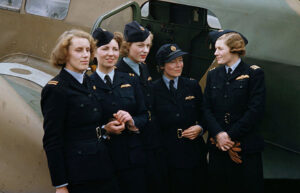
Much of World War II’s fighting took place in the skies, prompting aircraft manufacturers to design planes capable of performing under the extreme conditions of high-altitude combat. Once built, these aircraft still had to reach the pilots who would fly them into battle. That crucial task fell to the women of the Air Transport Auxiliary (ATA), affectionately known as the “Attagirls.”
Air Transport Auxiliary (ATA)

The Air Transport Auxiliary was headquartered at White Waltham Airfield in Berkshire. The civilian organization ferried military aircraft between access points across the United Kingdom, including assembly plants; active service squadrons; and airfields, scrapyards, delivery points, maintenance units and factories. The only locations they didn’t deliver to were aircraft carriers at sea.
The ATA’s staff was unconventional for the time, made up of women and men deemed unfit to serve on the frontlines. The organization was integral to the Royal Air Force (RAF), as it allowed able-bodied pilots to spend their time on the front, as opposed to ferrying aircraft between locations.
Over the course of World War II, the female pilots of the ATA flew approximately 415,000 hours, and they delivered more than 309,000 aircraft. There were 147 types in all, including the Supermarine Spitfire, the Hawker Hurricane, the North American P-51 Mustang and the de Havilland Mosquito, among others.
‘Attagirls’

The “Attagirls” was the nickname given to the women who worked for the Air Transport Auxiliary. They came from across Britain and neutral countries, and continued their work beyond the Second World War.
The training they received was different from pilots destined for combat. As they were required to fly within sight of the ground, they weren’t taught to use the onboard instruments. The women essentially flew blind, with just a map, a compass and a watch to guide them. As well, very little flight training was required, which differed from those serving on the frontlines.
The pilots often worked on a schedule of 13 days on, two days off. They also received equal pay for their work, which was a first for the British government. While initially restricted to flying non-combat aircraft, they were eventually permitted to pilot every type of aircraft flown by the Royal Air Force and the Fleet Air Arm (FAA), except for flying boats.
This group of women didn’t see combat during the conflict, but their job wasn’t without any risk. They dealt with similar weather conditions to pilots in the RAF and didn’t have the option of using navigational instruments. Over the course of the war, a total of 15 Attagirls lost their lives while on the job.
Pauline Gower

Pauline Gower, MBE, is widely recognized for persuading the British government to let women take to the skies as pilots. An accomplished aviator herself, Gower had amassed over 2,000 hours in the air, including flights for leisure travelers, and she used her expertise to advocate for women’s participation in the war effort.
‘Attagirls’ of the Air Auxiliary Transport (ATA)

Over 160 “Attagirls” flew for the Air Transport Auxiliary during World War II.
Mary de Bunsen was a debutante who wished to escape the balls she was expected to attend. Her way of doing this was to become a pilot. While she failed her first attempt at joining the ATA, she passed in August 1941, and was posted to the No. 15 all-women’s ferry pool in Hamble. Known for damaging the landing gears of Spitfires, she eventually requested a transfer to Scotland.
Rosemary Rees was one of the first to join the women’s section of the ATA. She’d taken up piloting in 1933, and had amassed over 600 hours before joining. In September 1941, she accepted the role as deputy to Margot Gore at the Hamble ferry pool, and by the end of the conflict was one of only 11 women to have flown four-engine bombers. Overall, she piloted 91 different aircraft and was one of the few to receive an MBE for her work.
Eleanor Wadsworth began her career with the ATA as an architectural assistant after seeing an advertisement for female pilots. After only 12 hours of training, she was deemed capable of piloting an aircraft and was one of the first six women to be accepted with little-to-no previous flying experience. Between June 1943 and September ’45, she was stationed at various ferry pools and flew 22 different types of aircraft. Her favorite was the Spitfire, which she flew 132 times.
More from us: How Two Families Escaped East Germany In A Hot Air Balloon
Margot Duhalde was a Chilean national who traveled to Britain with little understanding of English and no intention of flying for the ATA When she was 16, her father paid for her first flying lesson. By chance, a French pilot knew she was in England and offered to introduce her to the organization. She crashed shortly after joining, to the dismay of Pauline Gower, but persevered and returned to flying three months later.