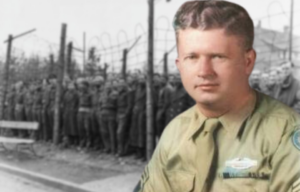
Roddie Edmonds’ early life and enlistment in the US Army

Roddie Edmonds was born on August 20, 1919, in South Knoxville, Tennessee. There isn’t much information about his childhood, but we do know he had three brothers, graduated from Knoxville High School in 1938, and was a member of a local Methodist church.
He joined the U.S. Army about nine months before the Japanese attack on Pearl Harbor in December 1941. At 22 years old, he enlisted at Fort Oglethorpe, Georgia.
Deployed to Europe

As the Second World War raged across Europe and the Pacific, Roddie Edmonds was sent to Europe with the 422nd Infantry Regiment, part of the 106th Infantry Division. Although he held the position of the highest-ranking noncommissioned officer (NCO) in his regiment, he never flaunted his rank.
“He did not throw his rank around,” fellow veteran Lester J. Tanner shared with Yad Vashem. “You knew he knew his stuff, and he got across to you without being arrogant or inconsiderate. I admired him for his command… We were in combat on the front lines for only a short period, but it was clear that Roddie Edmonds was a man of great courage who led his men with the same capacity we had come to know in the States.”
In December 1944, just five days before the Germans launched the Battle of the Bulge, Edmonds arrived in the European Theater. He fought bravely alongside his fellow soldiers in the 106th, but soon found himself surrounded by enemy forces.
Becoming a prisoner of war (POW)

Most of the men serving under Roddie Edmonds found themselves with no real option but to lay down their arms, outmatched by the advancing German forces and unable to escape capture. Although Edmonds held out a little longer, he ultimately conceded to the enemy on December 21, 1944.
After their capture, Edmonds and his unit faced a grueling ordeal as they were transported to Stalag IX-B, a prisoner of war camp near Bad Orb in Germany’s Hesse region. The trip was arduous: they marched about 50 kilometers to Gerolstein before spending seven harrowing days packed tightly into boxcars, with barely any food or water.
Upon arrival at Stalag IX-B, German guards sorted the captives into three groups: enlisted personnel, officers, and noncommissioned officers. As an NCO, Edmonds was soon transferred to Stalag IX-A, located near Ziegenhain, where his leadership and courage would later be put to the ultimate test.
Roddie Edmonds stood up for his Jewish comrades

Roddie Edmonds assumed the role of senior-ranking noncommissioned officer at Stalag IX-A, overseeing the camp’s 1,275 American prisoners of war.
On January 27, 1945, the camp commandant ordered Edmonds to present only the Jewish-American soldiers for roll call the next day, with the intent of segregating them from the rest. Sensing the threat this posed to his Jewish comrades, Edmonds defied the order and instructed all the POWs to gather outside their barracks.
Enraged, the commandant drew a pistol and demanded Edmonds identify the Jewish soldiers, threatening to kill him. Unfazed, Edmonds calmly responded, “We are all Jews,” and reminded the German officer that he would be held accountable for war crimes under the Geneva Convention if any harm befell the men, stating they were only obligated to provide their name, serial number, and rank—not their religion.
Recognizing he had been outwitted, the commandant lowered his weapon. Edmonds’ courageous stand is credited with saving the lives of between 200 and 300 Jewish soldiers.
Surviving the war

Roddie Edmonds was honored by Yad Vashem

After uncovering his father’s wartime journals, Chris Edmonds became deeply engrossed in the stories they contained. Seeking a fuller understanding, he connected with veterans who had served alongside Master Sgt. Roddie Edmonds at Stalag IX-A. Their testimonies highlighted the extraordinary breadth of Edmonds’ bravery and the lives he had protected, ultimately capturing the attention of Yad Vashem, Israel’s official Holocaust memorial.
In February 2015, Roddie Edmonds was posthumously recognized as “Righteous Among the Nations,” an honor reserved for non-Jews who risked their lives to save Jews during the Holocaust. Nearly a year later, on January 27, 2016—International Holocaust Remembrance Day—a formal ceremony was held at the Israeli Embassy in Washington, DC, with President Barack Obama in attendance.
Of the 25,000 individuals worldwide to receive this title, Edmonds is one of only five Americans—and the sole U.S. service member from World War II—to be granted this exceptional distinction.
Push to award Roddie Edmonds the Congressional Gold Medal

While happy his father was honored by Yad Vashem, Chris is pushing for more recognition from the United States. He’d initially sought for Roddie Edmonds to be awarded the Medal of Honor, but this was denied, as his actions didn’t occur in combat.
More from us: Witold Pilecki Risked His Life for the Polish Resistance By Voluntarily Being Imprisoned At Auschwitz
There has since been a push to posthumously award Edmonds with the Congressional Gold Medal, the highest civilian award handed out by the US Congress. This has had the backing of many, with the Master Sergeant Roddie Edmonds Congressional Gold Medal Act being introduced in the House on April 24, 2023.
There has been no notable action since this date.