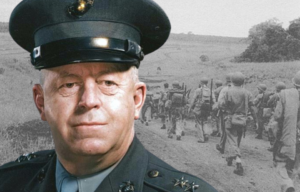
Merritt Edson’s entry into the US military

Merritt “Red Mike” Edson’s military career was characterized by impressive growth, beginning as a private in the Vermont National Guard and rising to the rank of major general in the US Marine Corps. Born in Vermont in 1897, Edson enlisted in the First Infantry Regiment of the National Guard in 1916.
After a hiatus, he resumed his education at the University of Vermont and, in October 1917, joined the Marine Corps Reserve, where he was commissioned as a second lieutenant. Though stationed in France with the 11th Marine Regiment, he did not see combat the First World War.
1st Marine Raider Battalion

After World War I, Merritt Edson held a variety of assignments and gradually developed a strong interest in aviation. By 1922, he had earned his pilot’s wings and was stationed at the Marine Naval Air Station in Guam, conducting reconnaissance over nearby islands—some of which would later bear his name. Medical issues, however, forced him to give up flying and return to ground duties.
Edson first saw combat during a deployment to Nicaragua in 1928–29, where he led a Marine detachment in active operations and earned the Navy Cross for outstanding leadership under fire. Throughout the 1930s, he steadily rose through the ranks, gaining extensive experience and eventually reaching the rank of colonel as global tensions moved closer to World War II.
In 1942, Edson took command of the 1st Battalion, 5th Marine Regiment and oversaw its transformation into the newly formed 1st Marine Raider Battalion. His bold and decisive leadership in the early stages of World War II—especially during the Battle of Guadalcanal—solidified his reputation as one of the Marine Corps’ most respected and legendary officers.
Merritt Edson prepare’s his men for a fierce encounter

In August 1942, U.S. forces landed on Guadalcanal and swiftly captured a half-finished Japanese airstrip. Once completed and renamed Henderson Field, it became a vital base for controlling the surrounding seas and skies—a prize the Japanese were determined to reclaim.
For months, the island was the scene of relentless, close-quarters combat. At the heart of the struggle was Col. Merritt Edson’s 1st Marine Raider Battalion. On the night of September 12, the Raiders, expecting a brief respite near the airfield, were instead met with a sudden, overwhelming Japanese offensive.
As enemy forces surged forward, Edson ordered a withdrawal to a ridge roughly 400 yards south of Henderson Field. There, he rallied his men, reformed their defenses, and prepared them to make a last stand. Through the chaos and exhaustion, his calm determination held the unit together. That narrow strip of high ground—soon immortalized as “Edson’s Ridge”—became the setting for one of the most heroic battles of the Guadalcanal campaign, where the Raiders’ resolve and sacrifice proved decisive in turning the tide.
Battle of Edson’s Ridge

As anticipated, approximately 2,500 Japanese soldiers emerged from the jungle and launched a full-scale assault against the 830 Marines. The Japanese forces initially succeeded in overrunning some Marine positions, leaving their flanks perilously exposed. One officer later recounted, “The Japanese attack was almost constant, like a rain that subsides for a moment and then pours the harder… When one wave was mowed down – and I mean mowed down – another followed it into death.”
As parts of the 1st Marine Raider Battalion started to retreat, they encountered Merritt Edson, who always knew exactly what to say to motivate them to fortify their defenses around Hill 123. It’s said his men would follow him anywhere, with their only challenge being to keep pace with him.
The morning after the intense engagement

As dawn broke the following morning, Merritt Edson’s Marines remained in control of Hill 123, having successfully repelled the Japanese assault. While the world may know this location as “Bloody Ridge,” those who fought there will forever remember it as Edson’s Ridge, a testament to their commander’s unwavering determination to defend it at all costs.
In recognition of his valor and leadership amid constant enemy fire, Edson was awarded the Medal of Honor, having earned the admiration and respect of every man who witnessed his actions. Throughout the remainder of the Second World War, he continued to serve with distinction, eventually rising to the rank of brigadier general and receiving his first star. Retiring from the Marine Corps in 1947 as a major general, Edson continued to serve his nation in various civilian capacities.
More from us: Was Herbert Sobel Really As Horrible As ‘Band of Brothers’ Made Him Out to Be?
In recognition of his exemplary service and bravery, not only did Merritt Edson receive personal awards for gallantry, but the USS Edson (DD-946), a Forrest Sherman-class destroyer, was commissioned in his honor. Furthermore, a section of Camp Pendleton, where Marine recruits hone their marksmanship skills, was dedicated in his name.