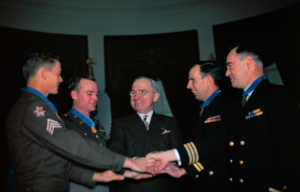
The Medal of Honor, the United States’ highest award for military valor, is traditionally presented by the sitting president. During many award ceremonies, Harry S. Truman remarked that he would rather have earned the Medal of Honor himself than serve as president.
Despite those comments, Truman firmly opposed any effort to award the decoration to him personally. He believed the honor should be reserved exclusively for those who demonstrated extraordinary bravery in combat and consistently rejected suggestions that he should receive it.
A controversial post-war president

Harry S. Truman is often regarded as one of the more divisive figures in American presidential history. During his time in office, he played a central role in rebuilding a devastated Europe through programs like the Marshall Plan, supported the establishment of the North Atlantic Peace Treaty (NATO), and took early steps toward advancing civil rights in the United States. However, many of his decisions—particularly those related to military affairs—remain the subject of enduring debate.
The most controversial among them was his authorization of atomic bombings against Japan at the end of World War II. The attacks on Hiroshima and Nagasaki, carried out using the bombs Little Boy and Fat Man, continue to provoke discussion. Critics argue the bombings were excessive and morally indefensible, and some suggest they also served as a strategic message to the Soviet Union. Supporters counter that the strikes brought Japan’s surrender and helped avoid the immense casualties expected from a potential invasion of the country’s mainland.
Truman nonetheless faced some of the most consequential decisions of any U.S. president. Having served as an artillery officer during World War I, he understood the realities of combat firsthand. Only five years after World War II ended, he committed American forces to the Korean War—a move that proved highly contentious and contributed to a decline in his domestic popularity.
Ultimately, Truman chose not to seek another term in office, acknowledging the political difficulty of continuing in a nation ready for new leadership. He was succeeded by Dwight D. Eisenhower, the celebrated Allied commander whose wartime reputation made him a dominant political figure.
Harry Truman turns down the Medal of Honor

In recent decades, Harry S. Truman has come to be viewed far more favorably by historians and the public, with many ranking him among the most effective American presidents.
Having guided the United States through the final stages of World War II and much of the Korean War, Truman was well acquainted with the significance of the Medal of Honor. Yet when the U.S. House of Representatives attempted to award him the medal in 1971, he wouldn’t accept it. Responding to the proposal at age 87, Truman stated, “I don’t consider that I have done anything which should be the reason for any award, Congressional or otherwise.”
Although he refused the decoration, Truman deeply appreciated the gesture itself. He wrote a letter that was read before Congress and addressed to Representative William J. Randall, he explained his reasoning. Truman believed the Medal of Honor should remain reserved exclusively for acts of extraordinary bravery in combat, and he felt altering the standards in his case would diminish the award’s meaning and prestige.
“This does not mean I do not appreciate what you and others have done, because I do appreciate the kind things that have been said and the proposal to have the award offered to me,” he wrote.
More from us: The Republic F-84 Thunderjet Was the ‘Champ of the Fighter-Bombers’
Truman passed away in 1972, just a year after his humble rejection of the Medal of Honor. After his death, President Richard Nixon said in a statement, “Harry S. Truman will be remembered as one of the most courageous Presidents in our history, who led the Nation and the world through a critical period with exceptional vision and determination.
“Embroiled in controversy during his Presidency, his stature in the eyes of history has risen steadily ever since. He did what had to be done, when it had to be done.”