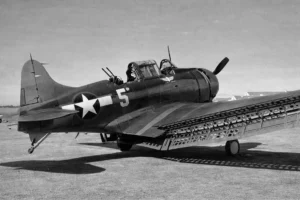
Military aircraft are built for the front lines, but few ever achieve the legendary ‘survivor’ status of Bureau Number 2106. This specific Douglas SBD Dauntless dive bomber managed to live through the two most consequential days of the Pacific War.
It was sitting on the tarmac during the Pearl Harbor attack and six months later, it was diving through a wall of fire to strike back at the Japanese fleet. This is the story of the ultimate survivor.
A Lucky Escape at Pearl Harbor

In early December 1941, the Dauntless (BuNo 2106) was supposed to be at sea. It was assigned to the aircraft carrier USS Lexington, but at the last minute, it was offloaded at Pearl Harbor to make room for other planes.
On the morning of December 7, 2106 was parked at Luke Field on Ford Island—the very center of the Japanese attack. While hangars exploded and ships sank in the harbor just yards away, this plane escaped the strafing runs and bombs without a scratch. While much of the Pacific Fleet lay in ruins, 2106 was still standing.
The Long Road to Revenge

After the attack, the U.S. Navy was desperate for payback. In May 1942, 2106 was sent to the tiny outpost of Midway Atoll and handed over to a group of Marine pilots.
On June 4, 1942, the Japanese fleet arrived at Midway to finish what they started at Pearl Harbor. Among the ships in the Japanese “Kido Butai” was the carrier Hiryū—one of the ships that had launched the planes that bombed Hawaii six months earlier.
2106 took off from Midway with a heavy bomb strapped to its belly. Its mission: find the Hiryū and sink it.
The “Suicide Mission” Over the Pacific

The battle was brutal. The Marine squadron (VMSB-241) was flying against elite Japanese Zero fighters and intense anti-aircraft fire. Of the 27 planes that left Midway that morning, only eight made it back.
2106 was one of the lucky few. Despite being swarmed by enemy fighters, the crew managed to drop their bomb on the Japanese fleet. When the plane finally limped back to the runway at Midway, it was a miracle it was still in the air. Ground crews counted more than 200 bullet holes in its wings and fuselage. One of its landing gear struts was shot away, but the pilot managed to touch down safely.
The “ghost” of Pearl Harbor had finally struck back.
From the Bottom of a Lake to a Museum

After Midway, the war-weary plane was sent back to the U.S. to help train new pilots. In 1943, during a training flight over Lake Michigan, the plane crashed into the water and sank to the bottom.
It stayed there, forgotten, for over 50 years. Because the water at the bottom of the lake is cold and fresh, the plane didn’t rust. When it was finally pulled up in 1994, it was in incredible condition.
Today, after a massive 70,000-hour restoration, the plane is on display at the National Naval Aviation Museum in Florida. It is the only aircraft in the world that can claim it was there for both the start of the war at Pearl Harbor and the turning point at Midway.