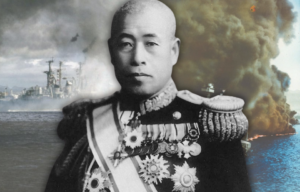
Isoroku Yamamoto’s upbringing and early career

Isoroku Yamamoto, born Isoroku Takano in 1884, rose to become one of Japan’s most prominent naval figures. His father, a mid-ranking samurai, was 56 at the time of his birth. In 1916, Yamamoto was adopted by the distinguished Yamamoto family—a common Japanese custom for households without a male heir—taking their surname and gaining association with a more prestigious samurai lineage.
Experience in the US, rivalry with the Japanese Army

Yamamoto spent a fair amount of time in the US during the 1920s and ’30s. He was a student at Harvard University from 1919-21. He also had two postings as a naval attaché in America, where he learned to speak fluent English. Yamamoto created controversy in 1937 when he apologized to the US for Japan’s 1937 bombing of the gunboat USS Panay.
The Imperial Japanese Army was significantly more aggressive and pro-war than its Navy, and was angered by Yamamoto’s opposition to a pact with Germany and Italy. Following his apology to the US, he received death threats, to which he said:
“To die for Emperor and Nation is the highest hope of a military man. After a brave hard fight the blossoms are scattered on the fighting field. But if a person wants to take a life instead, still the fighting man will go to eternity for Emperor and country. One man’s life or death is a matter of no importance. All that matters is the Empire.”
Attack on Pearl Harbor

Isoroku Yamamoto rose through the ranks of the Imperial Japanese Navy through a blend of sharp intellect, disciplined leadership, and an unusually forward-looking understanding of naval warfare. By November 1940, he had reached the rank of admiral, earning the respect of fellow officers and the confidence of the Imperial court, even as his more modern strategic outlook sometimes put him at odds with Japan’s traditionally minded Army leadership.
Despite his professional success, Yamamoto privately questioned the wisdom of going to war with the United States. He understood that Japan’s industrial output could not match that of America, and that a prolonged conflict would likely tilt the balance decisively against his country. This perspective shaped his approach to the planned attack on Pearl Harbor. If war was unavoidable, he believed Japan needed a swift and devastating blow to cripple the United States Pacific Fleet and buy time to consolidate its gains across the Pacific.
From a tactical standpoint, the attack achieved immediate success. Several American battleships were sunk or heavily damaged, and nearly 200 aircraft were destroyed or rendered inoperable in a single morning. Strategically, however, the strike proved disastrous. Rather than shattering American resolve, it galvanized the nation and unleashed the full power of its industrial and military capacity. In the end, Yamamoto’s earlier warnings proved accurate, and the conflict he had once cautioned against ultimately guided Japan toward defeat.
Battle of Midway and Yamamoto’s death

Despite initial Japanese successes after Pearl Harbor, Yamamoto advocated for continued attacks on the US Fleet. The Battle of Midway in June 1942 was intended to maintain Japanese offensive momentum. However, prior to the operation, US forces were able to break the Japanese Naval Code. This intelligence allowed Admiral Chester Nimitz to prepare effectively, resulting in a decisive US victory that shifted the course of the war.
Following setbacks and defeats at Guadalcanal and Midway, Yamamoto embarked on a morale-building tour for his forces. US intelligence intercepted and decrypted details of his itinerary, enabling American pilots to shoot down his plane on April 18, 1943. Posthumously, Yamamoto was honored with the title of Marshal Admiral and awarded the Order of the Chrysanthemum by Japan. Additionally, he received Germany’s Knight’s Cross of the Iron Cross.
Yamamoto’s legacy

Yamamoto has been featured in a number of films about Pearl Harbor and World War II. Moviegoers may remember him for the Tora! Tora! Tora! (1970) line that he may or may not have uttered: “I fear that all we have done is to awaken a sleeping giant and fill him with a terrible resolve.” The line was also referenced in 2001’s Pearl Harbor.
Historians, however, are not sure he ever actually made this observation.
Yamamoto was also portrayed by legendary actor, Toshiro Mifune, in three separate films: Rengo Kantai Ichokan Yamamoto Isoroku (1968), Gekido no showashi ‘Gunbatsu’ (1970) and Midway (1976).