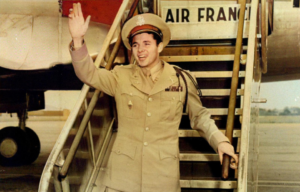
Audie Murphy’s impact extends well beyond his decorated military service and Hollywood career. Behind the public persona was a man molded by adversity, relentless perseverance, and steadfast courage.
Here are nine compelling glimpses into Murphy’s life, revealing the remarkable—and sometimes unexpected—moments that shaped the man behind the legend.
He was rejected from the US Navy and Marine Corps

Audie Murphy’s determination to enlist in World War II was sparked immediately after the attack on Pearl Harbor. Despite being young and underweight—reasons the Army, Navy, and Marine Corps initially rejected him—he refused to be deterred.
With his sister’s help, who adjusted his paperwork to make him appear older, Murphy finally secured a spot in the U.S. Army. Once he met the physical requirements, he began training at Camp Wolters in Texas, where he quickly stood out, earning both the Expert Badge with Bayonet Component and the Marksman Badge with Rifle Component.
After completing basic training, Murphy proceeded to Fort Meade, Maryland, for further infantry instruction, sharpening the skills that would prove vital during the intense combat he would soon face.
Audie Murphy single-handedly held off a company of German troops

In February 1943, Audie Murphy was deployed to the Mediterranean, where he engaged in action before being transferred to the European Theater – the setting of most of his wartime service. One particularly noteworthy incident during this period led to his receipt of the Medal of Honor.
By January 1945, Murphy was stationed in the Colmar Pocket with his platoon. Later relocated to Holtzwihr with the 3rd Infantry Division, they faced a German counterattack. Despite sustaining injuries, Murphy assumed command of Company B, prioritizing the safety of his men over his own well-being.
When the Germans ignited an M10 tank destroyer, Murphy directed his soldiers to retreat to the woods, away from enemy fire. Armed only with his M1 Carbine and a radio for artillery coordination, he climbed onto the armored vehicle and manned its .50-caliber machine gun, firing at the advancing troops for an hour and inflicting 50 casualties.
During this courageous act, Murphy sustained another injury to one of his legs. Undeterred by his wounds, he returned to his men and led a full-man charge against the German forces. Speaking about Murphy’s bravery, Pvt. Charles Owen recalled, “He saved our lives. If he hadn’t done what he did, the Germans would have annihilated us.”
The US Army changed how he viewed his name

During his younger years, Audie Murphy harbored a dislike for his first name. As a result, he often chose to use his middle name, Leon. His older sister had given him this name, not knowing its Latin meaning, “lion.” Interestingly, the name turned out to be appropriate, given Murphy’s extraordinary accomplishments during World War II.
It was when he joined the US Army that Murphy began to appreciate his first name. In the military, “Leon” was seen as a name from the countryside, so he started using the nicknames “Audie” or “Murph” for the rest of his life.
Awarded every US military combat award for valor – and then some

Audie Murphy stands as the most decorated soldier in the history of the United States—a title he didn’t just inherit, but earned through extraordinary valor on the battlefield.
Among his many accolades were the Medal of Honor, the Distinguished Service Cross, two Silver Stars, the Legion of Merit, the Bronze Star with Valor Device, and three Purple Hearts. His unit was twice awarded the Presidential Unit Citation, and he personally received the Army Outstanding Civilian Service Medal as well as the Texas Legislative Medal of Honor.
To these were added a long list of campaign and service awards, including the Good Conduct Medal, the American Campaign Medal, the European-African-Middle Eastern Campaign Medal, the World War II Victory Medal, the Army of Occupation Medal with Germany Clasp, and the Armed Forces Reserve Medal. He also earned several proficiency badges, such as the Combat Infantryman Badge, the Marksman Badge for rifle, and the Expert Bayonet Badge.
And these were only his American decorations.
Murphy’s heroism was also recognized abroad. France honored him as a Chevalier of the Legion of Honor and presented him with both the Croix de Guerre with Palm and with Silver Star, as well as the Medal of a Liberated France and the Fourragère in the colors of the Croix de Guerre. Belgium, too, awarded him the Croix de Guerre with Palm.
Audie Murphy suffered from battle fatigue for the rest of his life

Audie Murphy’s war continued long after he left the front lines. Diagnosed with what was then called “battle fatigue”—known today as post-traumatic stress disorder (PTSD)—he faced an inner struggle upon returning to civilian life. Haunted by sleepless nights, recurring nightmares, and constant anxiety, he turned to Placidyl, a heavy sedative prescribed to quiet his symptoms.
The relief, however, came with a steep price. Murphy grew dependent on the drug, and in a moment of resolve, chose to break free. Locking himself away in a motel room, he endured a punishing week of withdrawal entirely on his own, refusing medical help or outside support.
In an era when mental health was seldom acknowledged, especially among combat veterans, Murphy’s decision to speak candidly about his struggles broke barriers. He became an outspoken advocate for awareness and treatment of the unseen wounds of war, urging better care for returning veterans from Korea and Vietnam. His honesty and determination in confronting these hidden battles reflected a bravery every bit as profound as his heroism in combat.
He wanted to make a movie about Desmond Doss’ military service

There was a time when Audie Murphy wanted to create a film about fellow Medal of Honor recipient Desmond Doss. Doss had earned the prestigious decoration for his heroic actions at Hacksaw Ridge during the Battle of Okinawa, risking his life to treat wounded comrades, even under relentless enemy fire. He ended up saving 75 men.
Hal B. Wallis, producer of Casablanca (1942), enlisted Murphy to persuade Doss to sell his story to Hollywood. However, he did not see himself as a hero and refused the offer, fearing his character might be misrepresented or compromised. It wasn’t until the release of Hacksaw Ridge in 2016 that Doss’s extraordinary bravery was finally brought to the big screen.
Audie Murphy portrayed himself in To Hell and Back (1955)

It’s rare for anyone to have a movie made about their life, and even more extraordinary to star as themselves in it. Audie Murphy is one of the few who accomplished this, playing his own role in the 1955 film To Hell and Back, based on the 1949 autobiography written by his friend David McClure.
To Hell and Back portrays Murphy’s World War II experiences and features a cast that includes Jack Kelly, Marshall Thompson, Charles Drake, Gregg Palmer, and Paul Picerni, among other notable actors. The film debuted on the anniversary of his discharge from the US Army and received mostly positive reviews.
Despite being poor, there were still products he wouldn’t promote

In his later life, Audie Murphy faced serious financial challenges. A failed oil venture in Algeria resulted in losses of several hundred thousand dollars, further strained by substantial IRS tax liabilities.
Even under such pressure, Murphy stayed true to his values. He turned down lucrative endorsements for cigarettes and alcohol, declining any opportunities that might send the wrong message—especially to the young admirers who looked up to him.
Audie Murphy is buried at Arlington National Cemetery

On May 28, 1971, Audie Murphy lost his life when his private plane crashed into the side of a mountain in Roanoke, Virginia, while en route to a business engagement. On June 7, in recognition of his military service, he was laid to rest with full military honors at Arlington National Cemetery.
More from us: Henry Fonda Served In the US Navy During WWII – He Didn’t Want to ‘Be a Fake In a War Studio’
Given his status as both a famous actor and a decorated soldier, Murphy’s gravestone fast became a high-traffic area, becoming the second-most visited at Arlington, after that of President John F. Kennedy. The amount of visitors prompted the construction of a flagstone walkway, and those wishing to visit the gravesite can find it in Section 46, across from the Memorial Amphitheater.