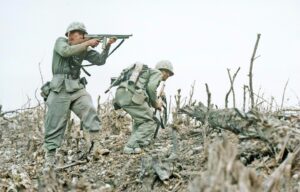
As World War II drew to a close, U.S. military leaders developed an ambitious plan called Operation Downfall—a two-stage invasion intended to force Japan to surrender unconditionally. Planners anticipated enormous casualties, knowing that Japanese forces, along with many civilians, were expected to fight fiercely to the end.
The operation called for a massive Allied landing on Japan’s home islands, supported by an enormous logistical effort to keep the invasion moving forward. Ultimately, the plan was never carried out. Events overtook it, and Operation Downfall was formally canceled before a single landing took place.
Developing Operation Downfall

Following the success of D-Day, it was clear that victory in Europe was approaching, yet the Pacific theater remained a daunting struggle.
In early 1945, Allied commanders convened at the Argonaut Conference to plan Japan’s defeat. It was during these discussions that the outline for Operation Downfall—the enormous proposed invasion of the Japanese home islands—was first established.
Planners anticipated that the European campaign would conclude by July 1, 1945, and that the Okinawa invasion would finish by mid-August. Operation Downfall was structured as a two-phase assault: the first set for November 1945, with the second scheduled for early 1946.
The opening attack would rely on forces already deployed in the Pacific, while the second phase would bring in divisions transferred from Europe following Germany’s surrender. The invasion’s scale was staggering, conceived as even larger than the landmark Normandy landings.
Operation Olympic

Operation Olympic, the first stage of the broader invasion strategy known as Operation Downfall, was slated to commence on November 1, 1945. Its objective was to seize control of Kyūshū, the southernmost of Japan’s main islands. Launching from Okinawa—which had recently been captured in a bloody and pivotal campaign—American forces would use the island as the primary staging ground for both Olympic and the second phase, Operation Coronet.
The scale of the invasion was unprecedented. Plans called for a vast armada of 400 destroyers and escort ships, 24 battleships, and 42 aircraft carriers that would join the effort. Fourteen divisions and two regimental combat teams would lead the ground assault, supported by a combined Allied fleet that included four Commonwealth battleships and 18 aircraft carriers.
To ensure air superiority and protect landing forces, the Fifth, Seventh, and Thirteenth U.S. Air Forces were tasked with providing cover and striking enemy defenses. Meanwhile, the U.S. Strategic Air Forces in the Pacific (USASTAF) and Britain’s Tiger Force prepared to conduct long-range bombing runs, with support from the legendary RAF No. 617 Squadron—the “Dambusters.”
Operation Coronet

After planners expected Operation Olympic to end, U.S. military leaders turned their attention to a second—and much more decisive—attack aimed at taking control of Japan itself. This phase targeted the main island of Honshu and was set for March 1, 1946, a date known as “Y-Day.” The objective was to drive the fighting to the doorstep of Tokyo.
The plan called for 25 divisions from the U.S. First and Eighth Armies to land at Kujūkuri Beach and near Hiratsuka. From there, another 20 divisions would move inland to support the advance and maintain momentum.
To strengthen the assault, five divisions from the Commonwealth Corps—made up of British, Canadian, and Australian troops—were added later. Though not part of the original plan, these allied forces were meant to help surround Tokyo and push north toward Nagano, tightening the noose around Japan’s remaining defenses.
Operation Downfall’s success would have come at a heavy price

While the Americans created a concrete plan for invading Japan, Operation Downfall would have come at a heavy price. As part of the preparation, they did calculations to see what the estimated casualties would be. While the numbers varied, the outcome was always staggeringly high.
One approach taken by Fleet Adm. William Leahy was that the casualties would be similar in number to those experienced on Okinawa – 35 percent. This meant the invasion of Kyūshū alone would have resulted in 268,000 casualties. This number was similarly echoed by Intelligence Chief Maj. Gen. Charles Willoughby.
Some estimates were far higher. One study conducted during deliberations showed that the invasion of Japan would cause up to four million American casualties and around 10 million Japanese deaths. It was these figures that played a role in the decision to drop the atomic bombs.
Operation Ketsugō

As the US planned its invasion, Japan was busy fortifying its defenses. Recognizing the increasing likelihood of an Allied assault, Japanese officials anticipated an attack post-1945 typhoon season. Remarkably, they accurately guessed the invasion locations.
Japan readied itself to counter 90 Allied divisions—20 more than what was actually expected. By this time, Japan understood that victory was out of reach. Instead, the strategy was to inflict such heavy costs on the invaders that the Allies might consider a truce.
Operation Ketsugō, Japan’s resistance strategy, not only involved significant military forces but also mobilized civilians. An extensive training program was put in place for new troops, including frogmen, and 28 million men and women were prepared for the Volunteer Fighting Corps. Additionally, Japan intended to use kamikaze pilots to stop the Allied naval forces from reaching the shores.
Downfall of Operation Downfall

Ultimately, Japan’s preparations were for nothing, as its troops couldn’t withstand the attacks that brought World War II to a close. Before Operation Downfall could be put into action, the Americans dropped the atomic bomb Little Boy on Hiroshima, followed shortly after by Fat Man over Nagasaki. The Japanese surrender and the Soviet advance into Manchuria that followed solidified for the allies that Downfall was no longer needed.
Prior to this, the US really was actually preparing for the invasion. The country even went so far as to create almost 500,000 Purple Hearts in advance of the waves of injured Americans that would come out of Operation Downfall. Since they were never needed, the US military opted to hand out these medals in future wars; so many were made, in fact, that they were given out during the Korean War, in Vietnam, and during the wars in Iraq and Afghanistan.
As of 2020, it was believed there could be as many as 60,000 of these Purple Hearts yet to be given out.