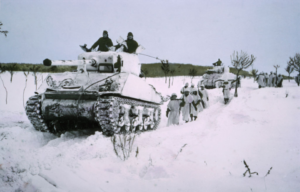
When the idea of a Christmas truce during wartime comes to mind, most people think of the famous 1914 pause in fighting that occurred along the Western Front. Far fewer are aware that a similar, though much more obscure, episode occurred thirty years later amid the chaos of the Battle of the Bulge in 1944. Even as one of World War II’s bloodiest confrontations raged on, opposing soldiers briefly set aside their weapons, allowing a short-lived but remarkable moment of peace to interrupt the violence of Christmas.
Battle of the Bulge

Fought from December 1944 into January 1945, the Battle of the Bulge represented Nazi Germany’s last gamble to reverse its losses on the Western Front. After the Allies broke out of Normandy on D-Day and pushed steadily eastward, many units paused in Belgium’s Ardennes region to regroup and replenish supplies. The dense forests, rugged landscape, and severe winter weather convinced Allied commanders that a major German attack was unlikely.
That sense of security vanished on December 16, when German forces unleashed a surprise offensive with more than 400,000 troops. The plan aimed to drive a wedge between Allied armies and seize the critical port of Antwerp, disrupting supply lines and morale. Bitter fighting erupted throughout the frozen countryside, as snow, fog, and forested terrain intensified the violence on both sides.
By the time Christmas arrived, German units near Foy-Nôtre-Dame found themselves surrounded and increasingly unable to sustain their advance. Once Allied reinforcements arrived and air superiority was restored, the German momentum evaporated. By January 28, the Allies had prevailed in a hard-won victory.
The failed offensive exhausted Germany’s remaining strength in the West, marking the end of any realistic hope for another major counterattack before the war’s conclusion.
A knock at the door on Christmas Eve

The battle in the Ardennes was intense and exhausting for soldiers on both sides, leaving them desperate for rest. A brief moment of respite came on Christmas Eve 1944, now remembered as a small truce in the midst of the fighting.
This story follows 12-year-old Fritz Vincken and his mother, Elisabeth. After their hometown of Aachen was destroyed by the ongoing war, they moved to the Hürtgen Forest in Germany, near the Belgian border. On Christmas Eve, they heard a knock at the door. When they opened it, they found three American soldiers, one of whom was badly wounded.
Even though the Americans didn’t speak German and the Vinckens didn’t understand English, they managed to communicate in French. Fritz’s mother welcomed the soldiers inside, and they shared a heartfelt exchange.
“We learned that the stocky, dark-haired fellow was Jim; his friend, tall and slender, was Robin,” Fritz later recalled. “Harry, the wounded one, was now sleeping in my bed, his face as white as the snow outside. They’d lost their battalion and had wandered in the forest for three days, looking for Americans, and hiding from the Germans. They hadn’t shaved, but still, without their heavy coats, they looked merely like big boys. And that was the way mother began to treat them.”
A second knock at the door

As Fritz Vincken’s mother prepared a meal of potatoes and a rooster for their guests, another knock came at the door. Thinking it might be more Americans, the 12-year-old opened it without hesitation—only to find four Wehrmacht soldiers standing outside.
The soldiers explained that they had been separated from their battalion and needed a place to stay until morning. Fritz felt a wave of anxiety, knowing that giving shelter to enemy troops—especially the Americans—was a crime punishable by death. Despite the risk, Elisabeth Vincken let the four men inside but made it clear that they were not the only guests and that they “may not consider friends.”
Although the Germans were initially upset, Elisabeth diffused the tension. “Listen. You could be my sons, and so could they in there,” she said. “A boy with a gunshot wound, fighting for his life, and his two friends, lost like you and just as hungry and exhausted as you are. This one night, this Christmas night, let us forget about killing.”
A short-lived truce on Christmas Eve 1944

The Germans left their arms at the door and entered the Vincken residence, after which the Americans did the same. After some time, the group loosened up, realizing that, at that particular moment, they weren’t enemies fighting on the battlefield, they were men celebrating Christmas Eve together. Before long, everyone had tears in their eyes.
As Fritz explained, “Relaxation was now beginning to replace suspicion. Even to me, all the soldiers looked very young as we sat there together. Heinz and Willi, both from Colonge, were 16. [Their] German corporal, at 23, was the oldest of them all.”
The corporal pulled out a bottle of red wine from his bag, while Willi offered up the rye bread he had with him. After saying grace, the unusual group – an innocent mother and her young son, three American soldiers and four Germans – began eating their meal, all hungry after a long day. One, who’d been a medical student before the Second World War, even looked at Harry, deeming that he needed “rest and nourishment” and adding that the cold temperatures had saved him from infection.
“Just before midnight, Mother went to the doorstep and asked us to join her to look up at the star of Bethlehem. We all stood beside her except Harry, who was sleeping,” Fritz recalled. “For all of us during the moment of silence, looking at the brightest star in the heavens, the war was a distant, almost-forgotten thing.”
Going their separate ways on Christmas Day

The next morning, everyone had a simple breakfast, including Harry, who had regained some strength overnight. After that, they made a stretcher using two poles and the Vinckens’ tablecloth so the two American soldiers could carry their wounded comrade. Before heading out, the three Americans checked their location on a map and, with the help of the German corporal, planned their route back to their own troops. The 23-year-old German even gave them a compass.
Soon after, both the Germans and Americans were given back their weapons. They shook hands and parted ways. As they left, Elisabeth said goodbye, telling them, “Be careful, boys. I want you to get home someday where you belong. God bless you all!”
Fritz Vickens hoped to reunite with the soldiers one day

Just before World War II came to an end, Fritz Vincken’s father, Hubert, returned home to his family. In 1959, he emigrated to the United States and opened a bakery in Honolulu, Hawaii. While building a life for himself in the US, he always remembered the soldiers he met on Christmas Eve 1944 and the mini truce that had occurred in that small cottage in the Hürtgen Forest.
In 1953, aware his chances of seeing the men again were slim, Fritz published his story in Reader’s Digest, an article US President Ronald Reagan referenced in 1985. Nine years later, he appeared on an episode of Unsolved Mysteries (1987-2002), intending to bring his story to a wider audience.
The television appearance worked, with a nursing home chaplain in Frederick, Maryland, contacting the producers of Unsolved Mysteries to inform them of a resident who’d served with the 121st Infantry Regiment, 8th Infantry Division during WWII. Fritz flew to Maryland and met Ralph H. Blank, who, at 76, was in poor health.
Their reunion was captured on camera, with Ralph telling him that his “mother saved my life,” indicating he was the “Harry” in Fritz’s story. Following their meeting, he told the Honolulu Star-Bulletin, “Now I can die in peace. My mother’s courage won’t be forgotten and it shows that goodwill will do.”
More from us: Why Did Japan Attack Pearl Harbor?
Fritz added in a 1997 interview that Elisabeth’s actions during the Christmas truce in 1944 taught him an important lesson, “The inner strength of a single woman, who, by her wits and intuition, prevented potential bloodshed, taught me the practical meaning of the words ‘good will toward mankind.’ I remember mother and those seven young soldiers, who met as enemies and parted as friends, right in the middle of the Battle of the Bulge.”