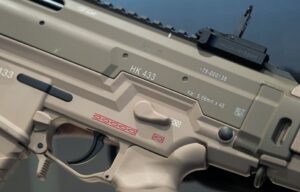
The G36 was a top contender in European infantries
Before 2012, the G36 was widely used across Europe by infantry, special forces, and security teams, valued for its reliability and versatility. Germany developed a lighter and more affordable weapon, using the standard 5.56 mm x 45 NATO cartridge and a proven gas-operated system with a rotating bolt. It officially entered service in 1996 as a modern, adaptable firearm.

But by 2012, the G36 was showing its age. New testing exposed a serious flaw: its accuracy dropped sharply when the rifle overheated. This led the German military to begin looking for a replacement.
Three main candidates were considered: the Heckler & Koch HK416, the Heckler & Koch HK433, and the Haenel MK556. After thorough testing, the HK416A8 was officially selected as Germany’s new service rifle in 2022. Still, the HK433 remains a popular option among firearms experts and continues to draw attention for its advanced design.
The HK433 is the future of assault rifles
The Heckler & Koch HK433 was developed as a potential successor to the Heckler & Koch G36, blending proven features from several of the world’s most widely used automatic rifles. Compact and highly adaptable, the HK433 allows users to choose between two familiar operating systems: one based on the M16 rifle/M4 carbine/AR-15 family, and another derived from the G36 system. This flexibility makes the rifle particularly attractive to a wide range of military and law enforcement users seeking both familiarity and modern performance.

The Heckler & Koch HK433 is available in six barrel lengths ranging from 11 to 20 inches, allowing it to be configured for a variety of missions and operating environments. The rifle is offered in two standard finishes—black and flat dark earth—and features fully ambidextrous controls, making it equally accessible for both left- and right-handed users. Notably, all adjustments can be made without the need for tools.
Among its standout features are a built-in round counter and a folding, adjustable stock with an integrated cheek rest. The rifle is also designed for extensive customization. Optional accessories include a training bolt group, suppressor, bayonet, drum magazine, brass catcher, blank-firing adapter, and mounts for a forward grip or bipod. Together, these options make the HK433 a highly versatile platform suited to the varied demands of modern military forces.
The HK433 has a solution for every problem

Heckler & Koch built the HK433 with straightforward adaptability in mind, making it immediately familiar to service members accustomed to the G36, HK416, or AR‑15 platforms. Fully ambidextrous controls and refined ergonomics shorten the learning curve, while the company emphasizes the rifle’s blend of reliability and intuitive operation. The design aims to bring modularity, accuracy, and safety together in a single, well-integrated system.
Developed for the realities of close‑quarters and urban combat, the HK433 incorporates practical, field‑proven features. It can be broken down without tools for rapid maintenance, and its safety mechanism allows the weapon to remain on safe even with a round chambered—a valuable capability when quick response is crucial.
Customization options are extensive: a full-length Picatinny rail and multiple attachment points accommodate optics, weapon lights, foregrips, and other mission‑specific gear. With a cyclic rate of roughly 700 rounds per minute—similar to the G36—the HK433 preserves a familiar shooting profile while pushing German service‑rifle engineering forward.
More from us: K31: The Swiss Rifle That’s Become a Popular Collector’s Item