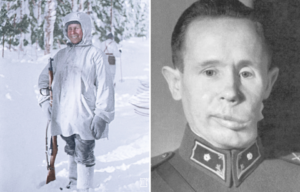
Photo Credit: 1. Julius Jääskeläinen / Wikimedia Commons CC BY 2.0 2. Finnish Military Archives - Tapio A.M. Saarelainen / Wikimedia Commons / Public Domain
The Winter War of 1939–1940 saw Finland’s relatively tiny military take on the massive Soviet Red Army. Although Finland ultimately had to cede some land, its forces gained worldwide admiration for their ingenuity and perseverance. One soldier, sniper Simo Häyhä, became legendary for his deadly accuracy. In just three months, he was credited with over 500 confirmed kills, earning the fearsome moniker “The White Death.”
Simo Häyhä’s early years in the Finnish Army
Simo Häyhä during his early years in the Finnish Army. (Photo Credit: Unknown / Wikimedia Commons / Public Domain)
Prior to the start of World War II, 17-year-old Simo Häyhä joined the Finnish militia. His skills with a firearm was noted at a young age, having been a hunter growing up. He also won numerous local marksmanship competitions. He didn’t, however, receive formal sniper training until 1938.
In 1925, Häyhä joined the Bicycle Battalion 2 as part of his 15-month compulsory military service. After attending Non-Commissioned Officer School, he joined Bicycle Battalion 1 as a conscript officer.
When the Soviet Union launched an illegal invasion of Finland on November 30, 1939, triggering the start of the Winter War, Finnish soldiers and everyday citizens leapt into action to defend their country. Aside from being an attack on the country’s sovereignty, the invasion violated the Treaty of Tartu, which the USSR and Finland had signed in 1920, following the Finnish Civil War.
The Finnish Civil War was a dramatic climax to an already tense situation, as they fought over whether to embrace their identity as a Scandinavian nation or side with the growing socialism movement in Russia. Unhappy with the results of discussions with Finland in the 1920s and ’30s, Russia chose to attack because it claimed that mistakes had been made when determining the Russian-Finnish border in 1917.
Simo Häyhä becomes known as “The White Death”
Simo Häyhä camouflaged in the snow during the Winter War. (Photo Credit: Unknown / Historia National Geographic / Archivos Militares Finlandeses / Wikimedia Commons / Public Domain):
Simo Häyhä served in a Finnish force of roughly 300,000–340,000 soldiers, defending against a Soviet invasion that numbered between 425,000 and 760,000 troops. Wearing white camouflage to blend seamlessly with the snow, he and his fellow snipers dug concealed positions, enduring harsh conditions where temperatures plummeted to −45°F.
Assigned to the 6th Company of Infantry Regiment 34 under Lt. Aarne Juutilainen, Häyhä developed clever strategies to survive both the cold and enemy detection. He layered clothing for warmth, carried bread and sugar for quick energy, and often crawled into position before dawn, remaining immobile until nightfall. To prevent his breath from giving away his location, he would hold snow in his mouth.
Häyhä favored the SAKO M/28-30, a Finnish adaptation of the Mosin-Nagant rifle he had mastered during his time with the Civil Guard, but he was also skilled with the Suomi KP/-31 submachine gun. His extraordinary precision allowed him to hit targets within a meter at 150 meters, making him one of history’s deadliest snipers. Over just 100 days, he recorded more than 500 confirmed kills—a figure verified by both his own records and fellow marksmen’s accounts.
His ghostlike presence in the snow, combined with his astonishing lethality, earned him the terrifying nickname “The White Death,” a title that struck fear into Soviet forces and came to embody Finnish determination and resilience.
Left for dead, but still alive
Simo Häyhä after being shot by a Red Army soldier in March 1940. (Photo Credit: Finnish Military Archives – Tapio A.M. Saarelainen / Wikimedia Commons / Public Domain)
On March 6, 1940, Simo Häyhä was struck in the jaw by a Soviet soldier’s bullet. Believed to be dead, his body was dumped onto a pile of casualties—until a comrade noticed his leg twitching. Severely wounded and unconscious, Häyhä had suffered devastating damage to his upper and lower jaw as well as his left cheek.
A few days later, he regained consciousness in a hospital and read a newspaper reporting his own death—a false story the Soviets had circulated to claim victory. That very day, Finland and the Soviet Union signed the Moscow Peace Treaty, officially ending the Winter War.
Simo Häyhä’s later life and legacy
Simo Häyhä with his sniper rifle. (Photo Credit: Unknown / Wikimedia Commons / Public Domain)
After a grueling 14 months in the hospital, during which he underwent 26 surgeries, Simo Häyhä returned home. He’d wished to fight in the Continuation War, but was excused due to his injuries. He was given a farm in southeast Finland, where he bred dogs and hunted moose. He struggled to come to terms with his role, even receiving death threats from his own people. Häyhä never married or had any children.
Despite his notoriety, Häyhä never boasted about his wartime accomplishments. During a 2001 interview, he was asked if he felt remorse over his actions during the war. He replied, “I did what I was told to do, as well as I could. There would be no Finland unless everyone else had done the same.” He died on April 1, 2002, at the age of 96.
Häyhä was honored with the First and Second class Medals of Liberty, as well as the Third and Fourth class Crosses of Liberty. He donated his SAKO M/28-30 honorary rifle, which was a gift from a wealthy Swedish businessman, to the Karelia Jaeger Battalion’s Heritage Room, after which it was transferred to the Finnish Military Museum. In 2017, his long-hidden memoir, titled Sotamuistoja, was discovered.