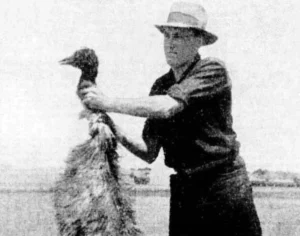
In 1932, Australia aimed machine guns at “swarms” of emus—and learned a truth that modern drone warfare keeps repeating: cheap, fast, scattered targets can make powerful tools look clumsy.

If you ever wanted proof that war is sometimes less “glory” and more “please make this problem go away,” Australia’s Great Emu War delivers. Picture this: It’s 1932 in Western Australia’s wheatbelt. Farmers are furious. Crops are getting hammered. Fences are being busted. And the culprits aren’t raiders or rebels—they’re emus, tall, tough, and annoyingly good at not standing still.
Why the Government Called In the Army

The context wasn’t a joke to the people living it. Large numbers of emus were moving into the Campion district and surrounding wheat-growing areas, and farmers petitioned for help. Canberra agreed to provide military assistance, approving a short, targeted culling operation. Modern retellings often cite around 20,000 emus involved in the broader problem—big enough to feel like a moving, feathered disaster.
This is how a wildlife-management mission ended up sounding like a campaign order.
The “Force”: Three Soldiers and Two Lewis guns
The deployment was small but real: three members of the Royal Australian Artillery, led by Major Gwynydd Purves Wynne-Aubrey Meredith, armed with Lewis machine guns and thousands of rounds. The intent was simple: reduce the emu population and relieve pressure on farms. In practice, it became a masterclass in how a “swarm” behaves when it doesn’t cooperate.
Because emus didn’t bunch up neatly, they split, sprinted, and flowed around pressure like water—breaking into smaller groups that were hard to track and even harder to hit efficiently.
“Emu War Over” (and Then… Not Over)
After early frustration, the press pounced. On November 9, 1932, a Perth paper ran the blunt headline “EMU WAR OVER.”
But the story didn’t end there. The operation resumed and ran through early December. Meredith’s report later claimed 986 confirmed kills, with a much bigger number sometimes suggested if wounded birds are included—figures that are regularly treated with caution today. Either way, the result was clear: it made minimal impact on the overall emu population, and it did not solve the farmers’ wider problem.
The Modern Echo: Emus and Drone Swarms

Here’s why the Emu War still feels oddly relevant. In 1932, Australia had powerful weapons, but the “enemy” didn’t fight like an army. The emus moved in loose groups, split up fast, and kept coming. That made it hard to finish the problem, even if you could hit a few targets.
Modern militaries face a similar headache with drone swarms and cheap loitering drones. The point isn’t always to land a perfect strike. Often, it’s to overwhelm the defender: send lots of low-cost drones so air defenses have to respond again and again—turning every interception into a drain on time, attention, and money.
That’s the same lesson in a new costume: firepower isn’t the same as control. You can shoot down some drones—just like you can shoot some emus, but if the targets are numerous, scattered, and inexpensive, you may end up spending far more to stop them than the attacker spent to launch them.
This explains Ukraine’s push for lower-cost interceptor drones—a way to defend the sky without using up limited, expensive missiles on every incoming threat. It’s essentially an attempt to win the economics of defense, not just the shootout.
What Actually Worked in 1932
Australia eventually leaned into solutions that were less dramatic and more practical: bounties, ammunition support, and fencing. By 1934, roughly 57,000 bounties for dead emus were claimed in six months—far more “effective” on paper than a short machine-gun campaign.
The Great Emu War lives on because it’s funny—yes, but also because it’s a clean historical reminder: when your opponent behaves like a swarm, winning often depends less on bigger weapons and more on better systems.
If you love reading about other crazy wars, then try: