In early 1942, the island of Singapore was the crown jewel of the British Empire’s Pacific defenses. Guarded by the massive 15-inch “Monster Guns” of the Johore battery and garrisoned by nearly 90,000 Commonwealth troops, it was known as the “Gibraltar of the East.” Winston Churchill himself had famously reassured the public that the fortress was “impregnable.”
But the “fortress” didn’t fall to a traditional naval armada. It fell to a logistical nightmare that the British never saw coming: an army on two wheels.
The Death of the “Singapore Strategy”

British military doctrine at the time was based on the “Singapore Strategy.” It assumed that any Japanese attack would come from the sea. Consequently, the island’s massive guns were bolted into concrete, aimed southward toward the water.
The British believed the dense, 600-mile stretch of the Malay Peninsula to the north was a natural shield. They categorized the thick jungles and monsoon-soaked marshlands as “impassable for tanks and heavy vehicles.” They assumed any army attempting a land-based invasion would be bogged down for months, allowing the British Navy plenty of time to arrive and save the day.
General Tomoyuki Yamashita, commander of the Japanese 25th Army, realized that if his troops didn’t need the roads, the “impassable” jungle became an open door.
The “Silver Wheels” and the Rim-Rider Trick

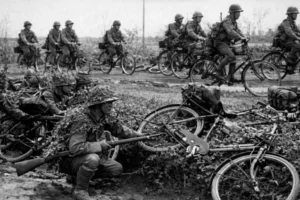
Yamashita deployed roughly 15,000 bicycle-mounted infantrymen. These weren’t rugged military machines; many were simple, civilian-grade bikes requisitioned from local shops. This “Silver Wheels” strategy gave the Japanese a level of mobility that the motorized British forces couldn’t match.
As the Japanese pushed through the intense tropical forest, their tires could get punctured on the rough terrain. Instead of stopping to repair them, the soldiers stripped the rubber off and rode on the bare metal rims.
This created a strange, rhythmic “clacking” sound on the paved sections of the road. In the eerie quiet of the jungle, British outposts heard the metallic grinding approaching from miles away. Deprived of clear intelligence, many units panicked—they mistook the metallic clatter for the sound of treads from a tank division. Entire British platoons retreated from defensible positions because they were terrified by what was actually nothing more than a few thousand broken bicycles.
Why the Bicycle Outperformed the Tank

While the British were “road-bound”—relying on heavy trucks and Bren Gun Carriers that were easily trapped by blown bridges—the Japanese used the bicycle to remain “terrain-independent.”
- Logistics: The Japanese required no fuel convoys. Every soldier was his own mechanic.
- Portability: When a bridge was destroyed by retreating Allied forces, the Japanese didn’t wait for engineers. They simply slung their 20-pound bikes over their shoulders and waded across the rivers.
- Speed: They maintained a relentless pace of 20 miles per day, ensuring the British never had time to establish a cohesive “second line” of defense.
The Largest Surrender in British History

By the time the Japanese reached the narrow Strait of Johor, the British defenders were psychologically shattered. They had been outmaneuvered by an enemy they considered technologically “backward.” On February 15, 1942, Lieutenant-General Arthur Percival was forced to surrender.
Despite having nearly double the number of troops as the Japanese, the British were out of water, out of spirit, and out of options. Approximately 100,000 Allied troops were taken prisoner—the largest capitulation in the history of the British Army.
The “Bicycle Blitzkrieg” proved that in modern warfare, adaptability is more valuable than armor. Singapore didn’t fall because it lacked guns; it fell because it underestimated the power of 12,000 men on wheels.