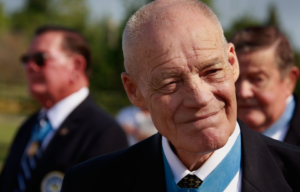
Robert L. Howard’s life reads like the plot of a war epic, yet every moment of it is real. Serving as a U.S. Army Green Beret in the Special Forces, he spent more than four years in Vietnam confronting some of the war’s fiercest fighting. During that time, he was wounded 14 times by gunfire, shrapnel, and burns, but repeatedly returned to the battlefield. His extraordinary courage and relentless determination eventually earned him recognition as the most decorated American soldier of the Vietnam War.
Howard’s list of honors is remarkable: eight Purple Hearts, four Bronze Stars, a Silver Star, and the Distinguished Service Cross. His highest distinction came when he received the Medal of Honor for a mission in which he braved intense enemy fire to rescue members of his team despite being seriously wounded himself. In an extraordinary testament to his valor, he was nominated for the Medal of Honor three times within a single year. Beyond the medals and citations, Howard’s enduring legacy rests on his unwavering loyalty to his fellow soldiers and his steadfast commitment to a principle deeply rooted in military service—never leaving a comrade behind.
Robert Howard and the 5th Special Forces Group (Airborne)

Robert Howard was born in Opelika, Alabama in 1939 and enlisted in the US Army in 1956. His first deployment was in 1965, with the 101st Airborne Division. He’d completed a few tours in Vietnam before attending Special Forces training, returning to Vietnam in 1967 as a sergeant first class with the 5th Special Forces Group (Airborne).
It was during his time serving in Vietnam that Howard would be recommended for the Medal of Honor – not once, but on three separate occasions. He was only awarded it once. It’s believed the reason he wasn’t given it all three times had to do with his assignment as a staff sergeant with the top secret Military Assistance Command, Vietnam – Studies and Observations Group (MACV-SOG). The US military didn’t want to draw attention to his work on classified missions.
Presented with the Distinguished Service Cross

On November 27, 1967, Robert Howard was serving as an adviser to a reconnaissance patrol when they unexpectedly stumbled upon an enemy bunker complex near the Laotian border. A fierce firefight erupted, and Howard took cover beside one of the bunkers, only to find himself pinned down under heavy machine gun fire.
Despite the relentless attack, Howard managed to throw a grenade into one of the bunker openings, eliminating all the enemy personnel inside. He then grabbed an anti-tank weapon, “rose up amidst the relentless barrage of bullets, fired his weapon, and completely destroyed the position.” His courageous actions created an opportunity for him and his team to be safely evacuated by helicopter.
For his extraordinary bravery during the battle, Howard was nominated for the Medal of Honor but was ultimately awarded the Distinguished Service Cross.
Heroics earned Robert Howard a Silver Star

In November 1968, deep in the jungles of Laos, Robert L. Howard led a Hatchet Platoon from FOB-2, one of the most elite units within MACV‑SOG, on a highly classified mission. After several days navigating hostile terrain, the team suddenly stumbled into a devastating ambush. North Vietnamese forces opened fire with rifles and grenades and even deployed a Soviet-made PT-76. Acting without hesitation, Howard grabbed an anti-tank weapon and destroyed the vehicle, a decisive move that likely saved his platoon from being overrun.
The situation worsened when a Medevac helicopter sent to evacuate the wounded was struck by enemy fire and burst into flames. Although already seriously injured, Howard ran nearly 300 yards across open ground under relentless gunfire to reach the crash site. There, he pulled both pilots and a critically wounded door gunner from the wreckage, carrying them to safety while sustaining additional injuries himself.
Through the long night, the platoon fought desperately to hold their ground. At first light, Howard led a bold counterattack, locating and destroying the 37-millimeter anti-aircraft gun responsible for bringing down the Medevac. Eliminating the weapon finally allowed helicopters to return and extract the battered team.
Despite the extraordinary heroism displayed during the mission, Howard received the Silver Star rather than the Medal of Honor. Even so, the award stands as powerful recognition of his courage, leadership, and unwavering resolve during one of the Vietnam War’s most dangerous covert operations.
Third time’s the charm – Robert Howard receives his Medal of Honor

In December 1968, Robert Howard joined a rescue mission to recover Special Forces Sgt. Robert F. Scherdin. Scherdin was part of a 10-man team deployed at the junction of Laos, Cambodia, and South Vietnam. The team had split into two groups, both of which came under enemy attack. Severely wounded, Scherdin was left behind when the patrol was forced to retreat.
The next morning, Lt. James Jerson sent his Special Forces commando platoon, including Howard and a group of Montagnard tribesmen, to rescue Scherdin. Along the way, Jerson and Howard were hit by a remotely detonated mine, seriously injuring them, and the rest of the platoon was attacked by the enemy.
Despite injuries to his legs and hand, Howard moved swiftly through enemy fire to reach Jerson and pull him to safety. A helicopter evacuated the platoon after Howard successfully rescued Jerson, but Jerson later succumbed to his injuries. Scherdin was not found and was declared missing in action.
Howard’s bravery and resilience earned him another recommendation for the Medal of Honor, which was presented to him for having “crawled from position to position, administering first aid to the wounded, giving encouragement to the defenders and directing their fire on the encircling enemy.” President Richard Nixon presented him the medal on March 2, 1971.
Robert Howard’s life following the Vietnam War

Robert Howard spent a total of four and a half years fighting in Vietnam. He served with the US Army for 36 years, 33 of which were with airborne status. Howard retired as a full colonel in 1992, but continued to work with other veterans in some form. He even visited American troops who were stationed in Iraq.
More from us: The Ace of Spades Was Used By the 101st Airborne Before It Became the ‘Death Card’
Howard became the most decorated Green Beret and soldier since World War II. Among the aforementioned decorations, he was also awarded seven Army Commendation Medals, three Air Medals, the Defense Superior Service Medal, three Meritorious Service Medals, the Joint Service Commendation and four Legions of Merit.
The Special Forces veteran died of pancreatic cancer on December 23, 2009 and was buried at Arlington National Cemetery.