Defoliants as a ‘legal tactic of warfare’

During the Malayan Emergency (1948–1960), the British military experimented with defoliants to combat the Malayan National Liberation Army (MNLA). In an effort to reduce roadside ambushes against Commonwealth troops, they targeted vegetation to deprive guerrilla fighters of hiding places. The chemicals were also used to destroy crops that provided food for the MNLA.
Many Commonwealth soldiers who handled these defoliants experienced severe health issues from exposure. Additionally, reports suggest that upwards of 10,000 MNLA guerrillas and civilians were affected by the chemicals. The long-term environmental impact included significant soil erosion, which has persisted for decades.
This operation influenced the U.S. government’s view, particularly under the Kennedy administration, reinforcing the belief that using such chemicals in warfare was legal.
Agent Orange

The most frequently used “Rainbow Herbicide” during Operation Ranch Hand was Agent Orange, which was a mixture of equal parts 2,4,5-T and 2,4-D. The result of mixing these two chemicals unintentionally created a highly toxic dioxin known as TCDD.
Prior to the Vietnam War, Agent Orange was primarily used in agriculture, and it was also being sprayed on vegetation that grew around railroads and powerlines. When the idea for Operation Ranch Hand came about, the US military obtained a whopping 20 million US gallons – a staggering amount that accounted for 60 percent of the herbicides used in Vietnam.
Agent Orange was named for the barrels the herbicide came in, as were the other chemicals used throughout Operation Ranch Hand, such as Agent Blue and Green (used against crops) and Agent White (deployed when Agent Orange wasn’t available).
Following the decade-long operation, Agent Orange was banned by the United States, with all remaining stock sent to Johnston Atoll, where it was destroyed.
Launching Operation Ranch Hand

The idea for Operation Ranch Hand came following a request from South Vietnamese President Ngô Đình Diệm to help eliminate the jungle hideouts of the North Vietnamese and Viet Cong. That August, the United States helped the Republic of Vietnam Air Force conduct herbicide operations, with the success prompting President John F. Kennedy to authorize a larger operation under the US Air Force, with assistance from the US Chemical Corps.
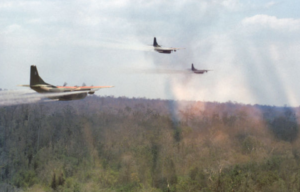
The chemicals deployed as part of Operation Ranch Hand were sprayed via pumps attached to aircraft (Fairchild C-123 Providers and Douglas C-47 Skytrains), helicopters, boats and trucks – even servicemen carried pumps on their backs. While all operations initially had to be approved by Kennedy, he eventually gave that discretion to the Military Assistance Command, Vietnam and the US Ambassador to Vietnam.
The first official use of herbicides in Vietnam outside of tests began in mid-January 1962. Not only were enemy locations such as hiding places, roads, waterways and crops targeted, but also the perimeters of American camps and airfields to keep them tidy.
A misguided belief the chemicals were harmless to one’s health

Between 2.6 and 3.8 million U.S. service members were sent to Vietnam while herbicides were being sprayed. When Operation Ranch Hand began, the military did not consider the risk to its own troops, so soldiers were not given masks or protective gear.
In a 1988 letter to Senator Thomas Daschle (D-SD), researcher James Clary, who was involved in the operation, explained, “When we initiated the herbicide program in the 1960s, we were aware of the potential damage due to dioxin contamination in the herbicide. However, because the material was to be used on the enemy, none of us were overly concerned. We never considered a scenario in which our own personnel would become contaminated with the herbicide.”
This turned out to be a serious mistake. While the exact number of service members affected is unclear, estimates suggest that over two million Americans suffered health problems because of exposure to the spray, its residue, or contaminated soil and water.
Operation Ranch Hand forever changed the region

Throughout the decade herbicides were sprayed on Vietnam and the surrounding countries, 20,000 sorties were flown over 6,542 missions. According to reports, 24 percent of South Vietnam was sprayed, with 500,000 acres of food crops and five million acres of mangrove trees destroyed.
In Vietnam, it’s been reported that at least 400,000 people died as a result of Operation Ranch Hand and the US military’s use of herbicides during the war, with 4.8 million believed to have been exposed to Agent Orange, in particular. Much of these numbers have been provided by the Vietnamese government, with American officials deeming them unreliable.
What wasn’t considered was the lasting impact of chemicals like Agent Orange on the environment – in particular, on waterways and the food chain. Those not directly exposed to the spraying, and even those who were, found themselves ingesting the various herbicides through the likes of meat and fish.
Operation Ranch Hand was also a breach of international law. Under the 1925 Geneva Protocol, the use of chemical and biological weapons in war is prohibited – and many approached the United Nations (UN) to put a stop to the atrocities being committed by the United States. However, the country’s delegation defeated most of the resolution.
Operation Ranch Hand’s impact on Laos and Cambodia

Birth defects in the descendants of American veterans

Many children of Vietnam veterans exposed to herbicides like Agent Orange were born with serious physical and mental health conditions. These included spina bifida, fused or extra digits, heart defects, underdeveloped organs, and various forms of cancer. Some also suffered from psychological disorders, and illnesses like Parkinson’s disease, Type 2 diabetes, and nerve damage have been reported among veterans and their families.
One such case was that of Mike Ryan, a Vietnam veteran whose daughter was born with severe birth defects: spina bifida, malformed limbs, a hole in her heart, and no lower digestive tract, among other complications. Neither side of the family had a history of such conditions, and both parents were healthy, with no record of smoking or drug use.
After learning of other children with similar health problems, the Ryans went public with their story. In 1980, President-elect Ronald Reagan met with the family to hear their concerns. However, once in office, his administration took steps to block a class-action lawsuit that would have compensated families like theirs. A federal judge, Jack Weinstein, later ruled that only disabled veterans or survivors of deceased veterans could receive compensation—excluding their children and other descendants.
Fellow veteran Royal Gee had a daughter prior to his service in Vietnam who is completely healthy and one born after his return. She suffered from cysts, joint problems and an immune system disorder. This led him to tell ProPublica, “They say it has nothing to do with my service in Vietnam and it stops right there. There’s got to be a reason.”
How has the US government responded?

Since the Vietnam War, extensive research has documented the enduring health consequences of herbicide exposure, consistently linking substances like Agent Orange to cancers, neurological disorders, and severe birth defects. This mounting evidence led to a landmark 1979 class-action lawsuit filed on behalf of 2.4 million veterans who had come into contact with these chemicals during their service. By 1984, several chemical manufacturers—including the primary producers of Agent Orange—agreed to a $180 million settlement, marking one of the first major legal recognitions of the human toll caused by the spraying program.
The settlement opened the door for further legal efforts, some directed at the U.S. government for authorizing the use of such toxic chemicals. Over time, the Institute of Medicine repeatedly called on the Department of Veterans Affairs (VA) to study the long-term consequences, including potential cognitive and developmental effects in the children and grandchildren of exposed service members.
Despite decades of advocacy, meaningful progress was slow. Only in recent years has the VA broadened its recognition of the wide spectrum of illnesses linked to Agent Orange exposure. For the families affected, this acknowledgment validates their experiences, even if it offers little solace after generations shaped by illness, uncertainty, and loss.
More from us: 5,000 War Dogs Served in Vietnam and Almost All of Them Were Left Behind
In 1991, President George H. W. Bush signed the Agent Orange Act, directing the U.S. government to formally acknowledge specific illnesses linked to herbicide exposure during the Vietnam War as service-connected. For veterans, this legislation marked a pivotal achievement, ensuring access to medical care and benefits without the need to prove a direct causal link between their health conditions and military service—a hurdle that had long prevented many from receiving proper support.