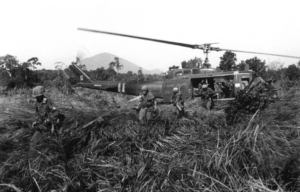
Richard Fitzgibbon Jr. was killed by a fellow comrade, but his death wasn’t recognized as an official Vietnam War casualty for decades

Photo Credit: Pictures From History / Universal Images Group / Getty Images

Historians continue to disagree on when the Vietnam War truly began. Some trace its roots back to 1887, when Vietnam was incorporated into French Indochina, while others identify 1946 as the starting point, when Ho Chi Minh launched armed resistance against French colonial rule. A different view highlights 1950, the year the United States began supplying major financial aid and military assistance to the French campaign.

For decades, though, the U.S. government formally designated 1961 as the beginning of American involvement for casualty classification. Because of that benchmark, personnel who died earlier—such as Air Force Tech. Sgt. Richard Fitzgibbon Jr., who was killed in 1956—were excluded from the official list of Vietnam War fatalities.

After sustained advocacy by Fitzgibbon’s family, the Department of Defense ultimately amended the recognized start date to November 1, 1955. This change ensured that those who lost their lives in the conflict’s early stages received formal recognition, correcting the historical record and honoring their sacrifice.

Richard Fitzgibbon Jr.’s untimely death

US Army advisor training a battalion of South Vietnamese soldiers
US Army advisor with the Military Assistance Advisory Group (MAAG) training a battalion of South Vietnamese soldiers. (Photo Credit: Department of the Army / Wikimedia Commons / Public Domain)

Richard Fitzgibbon Jr. was born on June 21, 1920, in Stoneham, Massachusetts, and served in two branches of the U.S. armed forces. He first joined the Navy during World War II before later transferring to the Air Force, where he rose to the rank of technical sergeant. While assigned to the Military Assistance Advisory Group (MAAG) in Vietnam, he played a key role in preparing South Vietnamese pilots for combat missions.

On June 8, 1956, while working as a crew chief, his aircraft was struck by hostile fire. During that mission, he had a tense disagreement with Staff Sgt. Edward C. Clarke, yet he maintained his professionalism, directing the radio operator to stay focused and finish the assignment.

That night in Saigon, Clarke—reportedly intoxicated and still angry—approached Fitzgibbon as he handed out candy to local children. In a sudden and tragic escalation, Clarke drew his weapon and shot him. Vietnamese authorities quickly intervened to detain Clarke, but during the apprehension he either fell or leapt from a second-story balcony, suffering injuries that resulted in his death.

Not classified as a casualty of the Vietnam War

Shadow of a Joint Services Honor Guard on the Vietnam Veterans Memorial
Member of the Joint Services Honor Guard reflected on the Vietnam Veterans Memorial prior to a wreath-laying ceremony to commemorate the anniversary of the Vietnam War, March 2016. (Photo Credit: Drew Angerer / Getty Images)

Richard Fitzgibbon Jr. died during the Vietnam War era, but at the time, his death wasn’t officially linked to the conflict. His family was heartbroken by the loss, and his son, Richard Fitzgibbon III, later enlisted in the U.S. Marine Corps to serve in Vietnam. Tragically, he was killed in 1965 after stepping on a landmine.

Their deaths represent one of only three known instances where both a father and son were killed in the Vietnam War.

In 1988, a relative named Richard DelRossi visited the Vietnam Veterans Memorial in Washington, DC. He was able to find the name of Richard Fitzgibbon III on the wall, but not that of Fitzgibbon Jr. This was because, at the time, the memorial only included names of those who died after 1961—the year the Department of Defense had designated as the war’s official start.

Richard Fitzgibbon Jr.’s family advocates for a change

Portrait of Ed Markey
Ed Markey (D-MA) helped the family of Richard Fitzgibbon Jr. finally achieve their goal of having his death recognized. (Photo Credit: U.S. Senate Photographic Studio – Rebecca Hammel / Wikimedia Commons / Public Domain)

After returning home, Richard DelRossi shared his father’s story with the rest of the family, and together they launched a petition to have Tech. Sgt. Richard Fitzgibbon Jr.’s name added to the Vietnam Veterans Memorial. Their efforts stretched almost a decade, but despite their persistence, they made little progress.

In 1997, their luck changed when they visited a traveling replica of the memorial and met U.S. Representative Ed Markey (D-MA). Deeply moved by the family’s account, Markey—who would later become a U.S. Senator—took up their cause. Although he encountered bureaucratic resistance, he remained committed. His determination paid off: the Department of Defense revised the official start date of the Vietnam War to November 1, 1955, coinciding with the establishment of the Military Assistance Advisory Group (MAAG) in Vietnam.

More From Us: This Silent Plane Flew Over Vietnam’s Treetops Undetected

Finally, on Memorial Day in 1999, the Fitzgibbon family stood before the Vietnam Veterans Memorial as Richard Fitzgibbon Jr.’s name was officially added—honoring the sacrifice they had long fought to have recognized.

Jesse Beckett

Jesse is a U.K.-based writer for Tank Roar, passionate about military history and storytelling through digital content. With a special focus on tanks and ships, Jesse brings a deep enthusiasm for historical narratives to every piece.