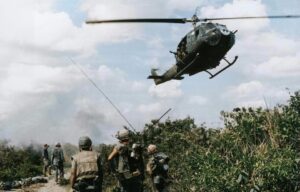
Hundreds of American helicopters were destroyed or damaged during Operation Lam Son 719 which sought to disrupt supply routes along the Ho Chi Minh Trail
Photo Credits: USMC / Getty Images (colorized by Palette.FM).
During the Vietnam War, helicopters emerged as a cornerstone of U.S. military operations, transforming how troops were deployed, how battles were fought, and how the wounded were evacuated. Their agility and speed allowed forces to move through dense jungles and difficult terrain that ground vehicles could not easily navigate. From air assaults and scouting missions to lifesaving medevac flights, helicopters became essential to American strategy.
The risks of this heavy reliance on air mobility became especially clear during Operation Lam Son 719 in early 1971. Designed to disrupt North Vietnamese supply routes along the Ho Chi Minh Trail in Laos, the operation depended largely on helicopter support. As U.S. and South Vietnamese troops pushed forward, they were met with intense anti-aircraft fire, resulting in hundreds of helicopters being destroyed or badly damaged, along with significant losses among aircrews.
The campaign revealed a critical limitation: despite their tactical advantages, helicopters were highly vulnerable in heavily defended areas. Lam Son 719 ultimately highlighted both the innovation behind helicopter warfare and the inherent risks that came with depending on it during the Vietnam conflict.
Helicopters were commonly used during the Vietnam War
A number of helicopters oversee an area during the Vietnam War. (Photo Credit: Patrick Christain / Getty Images)
At the onset of World War II, helicopters were still in their infancy, primarily experimental aircraft. By the Korean War, however, they had become vital for evacuating wounded soldiers quickly to medical facilities. It was during the Vietnam War that helicopters truly became a constant fixture on the battlefield, with the U.S. deploying over 12,000 machines for a variety of roles.
While indispensable for many missions, flying helicopters in Vietnam carried significant dangers. Approximately 40,000 pilots and 60,000 crew members operated in hazardous conditions, and tragically, 2,165 pilots and 2,712 crew lost their lives. These losses accounted for roughly eight percent of all American combat fatalities during the conflict.
Meant to aid the South Vietnamese during Operation Lam Son 719
A solider stands in a bunker along the Ho Chi Minh Trail. (Photo Credit: Bettmann/Getty Images)
The Ho Chi Minh Trail—winding through the dense jungles and rugged highlands of Laos and Cambodia—presented both political complications and serious operational challenges for U.S. planners. Although those countries were officially neutral, their remote landscapes became an unofficial battleground in efforts to cut off the Viet Cong’s crucial supply network. Thick jungle cover, narrow mountain routes, and well-hidden fortifications made the Trail extremely difficult to detect, let alone eliminate.
With ground incursions into Laos restricted, the United States depended heavily on air mobility. Helicopters such as the Bell UH-1 Iroquois and the Boeing CH-47 Chinook became essential assets. They carried South Vietnamese troops into combat zones, evacuated wounded personnel under fire, and transported artillery and supplies to isolated positions that were otherwise unreachable. Each mission, however, came with significant danger, as North Vietnamese forces reinforced key stretches of the Trail with anti-aircraft weapons and carefully planned ambushes.
Even with these risks, aerial operations remained one of the few effective ways to target the network. Despite sustained bombing campaigns and repeated assaults, fully disrupting the Trail proved nearly impossible.
The operation was intended to be a major step toward Vietnamization
Richard Nixon hoped Operation Lam Son 719 would help him achieve his goal of Vietnamization. (Photo Credit: Bettmann / Getty Images)
Operation Lam Son 719 was a central element of President Richard Nixon’s “Vietnamization” strategy, designed to transfer combat responsibilities gradually to the Army of the Republic of Vietnam (ARVN) as U.S. forces withdrew. In addition to its strategic goals, the operation sought to boost ARVN morale by showcasing their ability to operate independently.
Intended to last three to four months, the mission relied heavily on American air support to assist South Vietnamese troops advancing into well-fortified regions of Laos. The objective was to lure North Vietnamese forces into open battle, where concentrated airstrikes could deal significant damage.
Despite superior technology and extensive aerial backing, the operation ended in disastrous failure, revealing major flaws in planning, coordination, and execution.
US forces weren’t prepared for the North Vietnamese response
American troops on patrol as a helicopter flies in the background. (Photo Credit: Hulton Archive / Getty Images)
During the planning of Operation Lam Son 719, U.S. officials anticipated only light resistance from North Vietnamese forces. However, the People’s Army of Vietnam (PAVN) had already gathered intelligence and meticulously prepared their defenses. As a result, American helicopters encountered intense and almost constant anti-aircraft fire throughout the operation.
The damage was severe. Of the 750 helicopters used in more than 160,000 sorties, 108 were completely destroyed, and 618 were damaged—20 percent of which were beyond repair. In just two months, 72 helicopter crew members were killed, 59 were wounded, and 11 went missing.
In addition to helicopter losses, U.S. forces suffered substantial equipment damage: 163 armored vehicles, 71 tanks, 278 trucks, seven fixed-wing aircraft, 37 half-tracks, and 114 artillery pieces were either destroyed or captured by enemy forces.
The aftermath of the operation
Vietnamese soldiers look into a bunker along the Ho Chi Minh Trail. (Photo Credit: Bettmann/Getty Images)
Despite initially intending to execute Operation Lam Son 719 for 90-120 days, US troops withdrew after only 60. Nonetheless, President Nixon portrayed the mission as a success, conveying in a televised speech, “Tonight, I can report that Vietnamization has succeeded.”
Similarly, South Vietnam asserted the effectiveness of the operation, with President Nguyễn Văn Thiệu declaring it as “the biggest victory ever.”
However, it was North Vietnam that ultimately emerged as the victor. Construction of the Ho Chi Minh Trail persisted vigorously, extending it an additional 60 miles in length and 90 miles in width. The US also conducted a thorough review of their helicopter usage in battles, particularly questioning their survivability in hostile combat environments.