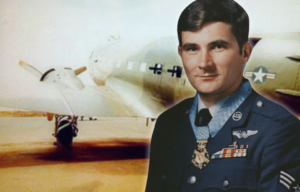
John Levitow’s enlistment in the US Air Force

John L. Levitow was born in Hartford, Connecticut, and entered military service in June 1966 by enlisting in the U.S. Air Force. His original intention had been to serve in the Navy, but a last-minute decision redirected his path toward the Air Force instead.
He initially trained as a civil engineer before transitioning into the role of loadmaster—a move that would prove pivotal to his service. As a loadmaster, Levitow was responsible for ensuring cargo was accurately calculated and securely fastened, arranging passengers to maintain proper aircraft balance, and overseeing critical aspects of in-flight safety and operational stability.
Incident in South Vietnam

On February 24, 1969, John Levitow was serving as loadmaster on a Douglas AC-47 gunship, call sign “Spooky 71,” assigned to the 3rd Special Operations Squadron. The aircraft was on a nighttime mission over South Vietnam, and Levitow’s duties included readying Mark 24 magnesium flares—setting their ejection and ignition timers before handing them to the gunner for release.
That night, Maj. Kenneth Carpenter, the pilot, spotted muzzle flashes near Long Binh Army Base and directed the crew to engage Viet Cong positions close to Tan Son Nhut Air Base. As Levitow and the gunner worked at the open cargo door deploying flares, a North Vietnamese mortar round struck the AC-47, instantly turning the mission into a desperate fight for survival for everyone aboard.
Extreme bravery in the face of mortal danger

The explosion left every crew member aboard the aircraft injured. John Levitow suffered a concussion and was pierced by more than 40 fragments of shrapnel in his back and legs. Amid the pandemonium, a live flare slipped from a gunner’s grip, threatening to detonate the aircraft’s munitions and endanger the entire crew.
Despite extreme pain and near unconsciousness, Levitow mustered the strength to crawl toward the hazardous flare. Using his body as a shield, he managed to throw it out the cargo door just in time. The AC-47 endured severe damage—over 3,500 holes riddled its fuselage and wings—but because of Levitow’s courageous intervention, the crew returned to base safely.
Presented with the Medal of Honor for exceptional heroism

John Levitow was awarded the Medal of Honor for exceptional heroism during wartime, making him the lowest-ranking airman to receive the US military’s highest honor. It was presented to him by President Richard Nixon in May 1970.
Among his other decorations were the Purple Heart, the Air Medal with silver and two bronze oak leaf clusters and the National Defense Service Medal.
John Levitow’s legacy

John Levitow passed away from cancer in November 2000 at the age of 55 and was laid to rest at Arlington National Cemetery.
To commemorate his legacy, the U.S. Air Force established the John Levitow Award, the highest honor presented to graduates of the Air Force Enlisted Professional Military Education program. The award is reserved for those who finish in the top one percent of their class, recognizing exceptional leadership and achievement.
Levitow’s legacy continued to grow in the years following his service. In 1998, he was inducted into the Airlift/Tanker Association Hall of Fame. Additionally, a Boeing C-17 Globemaster III was named The Spirit of John L. Levitow and initially assigned to the 437th and 315th Airlift Wings at Charleston Air Force Base in South Carolina. The aircraft was later reassigned to the 105th Airlift Wing of the New York Air National Guard, continuing to carry his name and story across the skies.