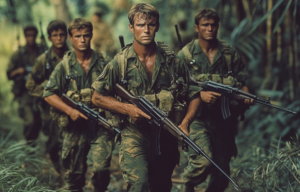
Military Assistance Command, Vietnam

John Stryker “Tilt” Meyer

John Stryker “Tilt” Meyer was one of the fearless men who volunteered to be an operative with MACV-SOG. He initially enlisted with the US Army in 1966, and soon after was accepted to Airborne School, where he was airborne certified.
By the following year, he’d graduated from the Special Forces Qualification Course, eventually becoming a member of MACV-SOG’s Spike Team (ST) Idaho. Meyer detailed much of his time in Vietnam in two books, Across the Fence: The Secret War In Vietnam (2003) and On the Ground: The Secret War in Vietnam (2007).
He was also one of the MACV-SOG commandos involved in the Thanksgiving Day mission in 1968, serving as a reconnaissance leader for a team of six. Aside from Meyer, ST Idaho consisted of four local mercenaries – Sau, Hiep, Phuoc and Tuan – as well as fellow American, John “Bubba” Shore.
30,000 missing enemy troops

By late 1968, U.S. intelligence agencies were intensely monitoring North Vietnamese Army movements following the shock of the Tet Offensive earlier that year. In January, NVA and Viet Cong forces had carried out widespread, coordinated assaults across South Vietnam, targeting major cities and population centers in an effort to spark popular uprisings and force the United States toward a withdrawal.
In the aftermath, analysts noticed a troubling development: three major NVA divisions—the 1st, 3rd, and 7th—had effectively disappeared from intelligence tracking. Combined, these units accounted for nearly 30,000 troops out of the roughly 100,000 forces being monitored. Their sudden absence near the Cambodian border raised fears that they were massing for a renewed, large-scale strike on Saigon. In response, U.S. leadership approved a classified mission known as ST Idaho, designed to locate the missing divisions, gather intelligence on their movements, and determine the scale of the looming threat.
MACV-SOG’s Thanksgiving mission

The task was simple enough: ST Idaho would enter Cambodia and locate the missing troops, after which they’d relay the information back to headquarters.
On Thanksgiving Day 1968, Meyer and his men waited in Bù Đốp Special Forces Camp, where the MACV-SOG team were delivered a Thanksgiving feast of turkey, gravy, mashed potatoes and cranberry rolls. A helicopter then arrived to deliver the men to Cambodia. This presented its own challenges, as they were only allowed to be brought 10 kilometers into the country via air and would then need to travel the remaining two kilometers on foot.
ST Idaho quickly disembarked the Huey and began their mission, searching for the missing NVA troops in the dense jungle. It didn’t take long for them to notice smoke, which they confirmed was from the soldiers they were looking for. The camp appearing empty, the MACV-SOG commandos began taking pictures and searching for important documents.
It appeared as though they’d successfully completed their mission – and rather quickly. Unbeknownst to them, however, they’d just walked into the middle of a 30,000-strong NVA encampment.
30,000 North Vietnamese versus six commandos

Sau was the first to alert Meyer about the danger ahead, urgently shouting, “Beaucoup VC! Beaucoup VC!” Even though Meyer had only been with MACV-SOG for five months—compared to Sau’s three years of experience—he trusted Sau’s instincts without question.
Moments later, North Vietnamese forces attacked from both sides. The MACV-SOG team quickly set up a Claymore mine and fell back under heavy fire. The enemy chased after them, but ST Idaho fought back hard, throwing grenades and setting off trip-wired Claymores to slow them down.
Help soon arrived as Bell UH-1P Huey helicopters from the U.S. Air Force’s 20th Special Operations Squadron swooped in, providing suppressing fire with M60 machine guns and M134 miniguns. As the helicopters hovered over the pickup zone, the six men sprinted aboard, setting one last Claymore mine at the edge of the landing area before making their escape.
Making it out of the Thanksgiving Day mission alive

Meyer later described the mad dash in his book, writing, “We had been moments away from a very violent death and we killed an untold number of NVA soldiers – soldiers who continued to earn our undying respect. I took no pleasure in killing the enemy. It was simply us or them.” They made it, however, with the Huey taking off before the NVA troops could reach them.
More from us: US Navy SEAL? Deadly Sniper? Debunking the Rumors About Mister Rogers’ Military Service
Successful in their mission, although a little worse for ware, the first thing ST Idaho did upon their return to base was visit the mess hall for a well-deserved second Thanksgiving dinner. Soon after, they were tracked down by the MACV-SOG officer who’d sent them on the mission, asking if they would join him for yet another Thanksgiving feast and discuss the mission. Meyer and Shore obliged, debriefing him over the well-earned meal.