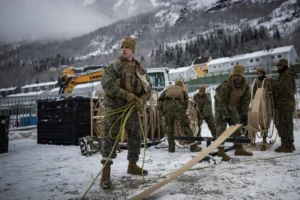
25,000 Allied Soldiers Are Training Where WWII Was Almost Won in the North
Right now, in the snow-swept fjords of northern Norway, something remarkable is happening. From March 9 to 19, 2026, troops from 14 allied countries are training under harsh Arctic conditions in Cold Response 2026 — Norway’s largest military exercise of the year.

At the heart of it all sits a small port city that has punched above its weight in military history for over 80 years: Narvik.
Nestled between a snow-capped mountain and the pristine Ofot Fjord, Narvik is one of the key places along Norway’s coast where NATO allies plan to land if Finland, Sweden, or Norway comes under attack. The rail line from Narvik to Kiruna in Sweden, and further east into Finland, is the primary artery for moving troops and equipment across Arctic Scandinavia.
That geography is no accident — and it wasn’t in 1940, either.
The Battle That Made Narvik a Strategic Name Forever

In April 1940, Germany launched Operation Weserübung, a bold plan to secure strategic footholds in Norway and Denmark. Control of Norway’s ports and fjords was critical for safeguarding iron ore shipments from neutral Sweden—a lifeline for the German war machine. Narvik, with its ice-free harbor and proximity to the Swedish ore fields, became a primary target.
The main strategic reason for Germany to invade Norway was to seize the port of Narvik and guarantee the delivery of iron ore needed for German steel production. Without that ore, the German war industry couldn’t function. Without Narvik’s ice-free harbor, the ore couldn’t reach Germany in winter when the Baltic froze over.
On April 9, 1940, German destroyers slipped through the Ofotfjord under cover of darkness and stormy weather, landing mountain troops who swiftly overwhelmed Norwegian coastal defenses. Narvik was captured by German troops that morning. Their objective was to gain control of the iron ore shipped from the Kiruna mine — a critical resource for the German arms industry.
But the Allies weren’t finished.
Germany’s First Defeat — and Why It Didn’t Stick

Just one day later, the Royal Navy struck back. The First Battle of Narvik took place on April 10, 1940, involving British destroyers under the command of Captain Bernard Warburton-Lee, resulting in losses on both sides. The German vessels, subsequently blocked in the fjord, were destroyed during the Second Battle of Narvik on April 13 by a British force that included the battleship HMS Warspite. Warburton-Lee was killed in the action and posthumously awarded the Victoria Cross.

What followed on land was one of the war’s most intense early campaigns. Norwegian, French, British, and Polish troops fought German mountain troops, shipwrecked Kriegsmarine sailors, and paratroopers in a two-month land campaign. Allied forces recaptured Narvik on May 28, 1940. For a brief window, it was the only active land battle in the entire Second World War.

The Germans at Narvik had held out against five times as many Allied troops until May 27. But by that time, the German offensive in France had progressed so much that the British could no longer afford any commitment in Norway, and the 25,000 Allied troops were evacuated just ten days after their victory, on June 7, 1940.
The victory was real. The outcome was bitter.
Why 2026 Looks Like 1940 on a Map
Cold Response 2026 is a natural part of Arctic Sentry, NATO’s new military initiative for the High North, designed to gather all allied Arctic activities under a single operational approach. The strategic logic driving troops back to these mountains and fjords is strikingly familiar: who controls the Arctic approaches controls the northern flank of Europe.
Norway has declared 2026 the year of “total defence”—the latest move by a Nordic nation to close the gap between military forces and civil society, because in a critical situation, there is a need for a lot of resources. Civilian hospitals, railways, and logistics hubs around Narvik are all being woven into the exercise, just as they were vital and vulnerable 86 years ago.
The names on the map have barely changed. The railroad to Sweden still runs through town. The fjord still freezes the same way. And the question of who can land troops here fast enough, in the worst conditions imaginable, remains as urgent in 2026 as it was when Germany made it its first strategic priority in the war.
If you liked this article, you may also like: