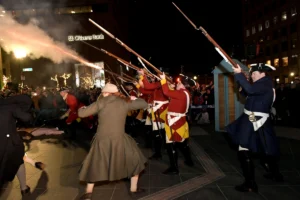
On March 5, 2026, Boston is doing what it does best: turning history into a live argument. Revolutionary-era sites downtown are back in full “walk it, don’t just read it” mode—including tours that revisit how the Boston Massacre was remembered and retold, right as the city marks the anniversary.
And outside the Old State House, where the confrontation happened, Boston’s long-running tradition of public commemoration keeps pulling new generations into an old question: what really happened on that street—and who got to tell the story afterward?
A City That Felt Occupied
By 1770, Boston wasn’t just irritated with Britain—it felt watched. British troops had been sent to enforce unpopular policies, and daily friction piled up in taverns, markets, and narrow streets. The Old State House sat at the center of that pressure-cooker Boston, and on a cold March night, the situation around a British sentry spiraled fast.
The Shots on King Street

The clash that became known as the Boston Massacre unfolded in minutes but echoed for years. A group of angry colonists, piqued about rising taxes and increased competition for jobs, picked on a sentry, harassing them with insults, ice, and clubs. When musket fire cut through the confusion, five men ended up dead or dying—including Crispus Attucks, often remembered as the first to fall, along with Samuel Gray, James Caldwell, Samuel Maverick, and Patrick Carr.
The funerals became a political moment of their own. Contemporary accounts and later historians point to a massive turnout—thousands of Bostonians walking together in public grief and anger—turning the tragedy into a shared civic memory, not a private loss.
The Image That Went “Viral” in 1770

If you want to understand why the Boston Massacre mattered, don’t start with the gunshots—start with the pictures.
Within weeks, colonists were circulating dramatic visuals of the event, the most famous being Paul Revere’s engraving, “The Bloody Massacre Perpetrated in King-Street Boston on March 5th 1770 by a Party of the 29th Regt.” It’s powerful, theatrical, and (crucially) not a neutral snapshot. Historians note that Revere copied much of it from another engraver, Henry Pelham, and staged the scene to make the crowd look harmless while the soldiers appear to fire in cold blood. In other words, it’s 18th-century persuasion, built to harden public opinion.
That’s why March 5 still lands in 2026. In an age of instant clips and instant certainty, the Boston Massacre is an early reminder that the first version of an event can outrun the complicated truth.
The Trial That Helped Define “American Justice”

Then came the twist many people forget: Boston didn’t just rage—it prosecuted.
British Captain Thomas Preston and soldiers faced trial, defended by John Adams, who later became the second president of the USA. He argued that the soldiers acted in self-defense. The outcome surprised plenty of patriots: Thomas Preston was found not guilty, and of the eight soldiers tried, most were acquitted, while two were convicted of manslaughter.
The crowd’s grief wasn’t illegitimate. The point was that the colonies were already practicing a radical idea: even hated enemies get due process, and evidence matters, even when emotions are boiling.
Why the Boston Massacre Still Echoes
The Boston Massacre may not have led to the Revolution all by itself, but it changed the temperature. It gave the resistance a martyr story, a rallying image, and a lesson in how outrage can be shaped, packaged, and amplified.
So on March 5, 2026, when Boston reenacts, tours, and remembers, the anniversary isn’t only about a tragedy on a snowy street. It’s about something the modern world wrestles with daily: how a single night can become a national narrative—and how hard it is to separate facts from the stories we most want to believe.
If you loved this article, you may love this interview with the actor who played Thomas Preston in History Channel series Sons of Liberty:
SONS OF LIBERTY