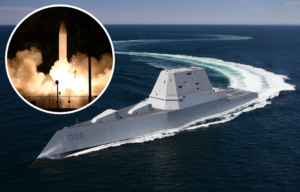
Zumwalt-class guided-missile destroyers will be the first in the U.S. Navy outfitted with hypersonic weapons

Photo Credit: 1. National Museum of the U.S. Navy / Wikimedia Commons / Public Domain 2. United States Navy / Wikimedia Commons / Public Domain

The U.S. Navy is pushing forward with its hypersonic weapons program, targeting missiles capable of traveling at more than five times the speed of sound. Although the original plan centered on deploying these weapons aboard cruise-missile submarines, the strategy has evolved. Chief of Naval Operations Adm. Mike Gilday recently revealed that Zumwalt-class guided-missile destroyers will now take priority for integration.

This shift reflects a deliberate move to accelerate hypersonic capability within the surface fleet. By equipping the advanced Zumwalt class first—vessels already known for their stealth and cutting-edge systems—the Navy aims to bring these next-generation weapons to operational readiness sooner, strengthening its position in an era of rapidly advancing global hypersonic competition.

Common hypersonic glide body being launched at night
Launch of a common hypersonic glide body at the Pacific Missile Range Facility in Kauai, Hawaii, 2020. (Photo Credit: United States Navy / Wikimedia Commons / Public Domain)

The Navy characterizes its upcoming hypersonic missile as a fast, highly accurate strike system built jointly with the U.S. Army. The weapon relies on a powerful rocket booster to launch a maneuverable glide vehicle that carries the warhead. Once the booster separates, the glide vehicle streaks toward its target at extreme speed while retaining the ability to shift course in flight.

By traveling above Mach 5 and following non-linear, hard-to-predict paths, hypersonic missiles pose a major challenge for modern air- and missile-defense networks. Few existing systems are capable of tracking and intercepting them with confidence. As a result, these weapons have become central to the escalating technological rivalry among the United States, Russia, and China—each racing to field faster, more agile, and more survivable long-range strike capabilities.

USS Zumwalt (DDG-1000) at sea
USS Zumwalt (DDG-1000) conducting sea trials in the Atlantic Ocean, December 2015. (Photo Credit: U.S. Navy / General Dynamics Bath Iron Works / Wikimedia Commons / Public Domain)

The Zumwalt-class of guided-missile destroyers include only three ships: USS Zumwalt (DDG-1000), Michael Monsoor (DDG-1001), and the soon-to-be-completed Lyndon B. Johnson (DDG-1002). The Navy received the lead ship in May 2016 and officially commissioned it later that year.

Northrop Grumman Ship Systems led the design, with Raytheon Company handling systems integration. Several other major defense contractors—General Dynamics Bath Iron Works, Lockheed Martin, BAE Systems Land and Armament, and Boeing—also contributed to the project.

Originally designed for operations in coastal waters, the Navy is now modifying the Zumwalt-class to function more effectively in open-ocean combat as long-range strike platforms. Their main weapon was supposed to be the Advanced Gun System with two 155 mm guns that used Long Range Land Attack Projectiles. However, with only three ships in the class, the cost of each round soared to nearly $1 million, forcing the Navy to rethink the plan.

A key obstacle in converting the Zumwalts to carry hypersonic missiles was that the missiles were still in development, and the ships’ existing vertical launch cells weren’t big enough to fit them

In mid-March 2021, the Navy reached out to defense contractors seeking proposals to modify the Zumwalt-class ships to accommodate hypersonic missiles. Their request called for an advanced payload module designed to hold the missiles in groups of three.

By August 2023, work had begun to retrofit the vessels, removing their 155 mm guns and installing four 87-inch missile tubes. Each tube will be capable of launching three Common Hypersonic Glide Body (C-HGB) missiles, giving the ships a strike range of approximately 1,724 miles.

Adm. Gilday also noted that the Navy is exploring how to leverage the Zumwalt-class’s robust power systems to deploy direct-energy weapons as a means of defending against new and evolving threats.

Helicopter flying alongside the USS Zumwalt (DDG-1000) as she leaves port
USS Zumwalt (DDG-1000), 2016. (Photo Credit: National Museum of the U.S. Navy / Wikimedia Commons / Public Domain)

The title ship in the class was the first to receive the hypersonic upgrade, which reportedly cost $155 million. Work is anticipated to be completed sometime in 2025.

More from us: USS Idaho Is The First Ship To Bear That Name In 100 years

After outfitting all Zumwalt-class guided-missile destroyers with the hypersonic missiles, the Navy plans to add the weapons to its Virginia-class submarines. The goal is to have the missiles fully installed on the former by 2028.

Ian Harvey

Ian Harvey is one of the authors writing for WAR HISTORY ONLINE