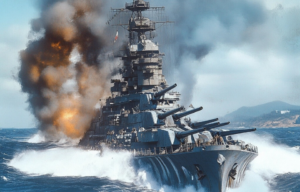
New York-class super-dreadnought battleships

The USS Texas was a New York-class battleship commissioned in March 1914, right before World War I. She was the second ship of her class and an upgrade from the older, less powerful Wyoming-class. Considered the U.S. Navy’s first true “super dreadnoughts,” Texas and her sister ship, USS New York (BB-34), were heavily armed, built for intense firepower and robust combat capability.
Their main armament consisted of ten 14-inch deck guns, supported by a variety of secondary weapons: four QF 3-pounder Hotchkiss saluting guns, twenty-one 5-inch guns, and two QF 1-pounder “pom-poms.” They also carried four torpedo tubes capable of launching Bliss-Leavitt Mark 3 torpedoes.
Beyond their firepower, Texas and New York were heavily armored and powered by water-tube boilers paired with triple-expansion steam engines. This setup gave them a top speed of just over 24 miles per hour and a cruising range of roughly 1,825 miles.
USS Texas‘ service during World War I

Since the United States did not enter World War I until April 1917, the USS Texas initially saw action following the Tampico Incident, a conflict sparked by rising tensions between US Navy sailors and Mexican soldiers. Shortly after her commissioning, Texas was dispatched to Mexico without undergoing the customary shakedown cruise, spending two months stationed off the coast of Veracruz.
After a short stint with the Atlantic Fleet, Texas returned to Veracruz. In 1916, she made history as the first US battleship to be outfitted with 3-inch anti-aircraft guns and to incorporate directors and rangefinders for controlling gunfire. Although these technologies have largely evolved, their fundamental principles are still applied today.
Texas alternated her training operations between New England and Virginia, conducting winter tactical and gunnery exercises in the West Indies. Once the US entered into WWI, the battleship crossed the Atlantic to join the Grand Fleet, where she witnessed the first American shots of the war.
While serving with the Grand Fleet, Texas supported the British squadron assigned to blockade operations in the North Sea. Working alongside other vessels, she also escorted American minelayers, contributing to the extensive North Sea Mine Barrage, a minefield stretching from Norway to the Orkney Islands off the northern coast of Scotland.
Interwar period

The USS Texas returned to the United States in late 1918. After escorting President Woodrow Wilson to the Paris Peace Conference for the signing of the Treaty of Versailles, the ship underwent an overhaul and resumed her duties with the Atlantic Fleet.
In 1919, Texas made history as the first U.S. battleship to launch an aircraft, a British-built Sopwith Camel. The ship also served as a navigational reference and protector for the Curtiss NC-4, the first seaplane to complete a transatlantic flight. Shortly after these milestones, the super-dreadnought was transferred to the newly-formed Pacific Fleet and received the designation BB-35.
During the interwar period, Texas underwent another overhaul, which included upgrading her anti-aircraft weapons with eight 3-inch guns. Her torpedo tubes were removed, and six of her 5-inch guns were relocated to casemates. After these modifications, she was named the flagship of the U.S. Fleet and carried out routine operations with the Scouting Fleet.
By the start the Second World War, Texas had undergone several additional refits and was assigned to the Training Detachment of the U.S. Fleet.
Operation Torch

At the start of World War II, the USS Texas joined the Neutrality Patrol and later spent six months near Iceland, patrolling the waters and escorting supply ships. She then took part in Operation Torch, the Allied invasion of North Africa, becoming one of only three U.S. battleships involved—alongside the USS New York and USS Massachusetts (BB-59).
As part of Task Group 34.8, Texas transmitted Gen. Dwight D. Eisenhower‘s “Voice of Freedom” message, encouraging the French not to resist the Allied landings. While she didn’t immediately face German forces, she was assigned to strike a Vichy French ammunition depot near Port Lyautey.
After finishing her mission in North Africa, Texas returned to the U.S. By April 1944, she was preparing for what would become her most important assignment: the D-Day invasion.
USS Texas (BB-35) makes a risky decision on D-Day

What happened to the USS Texas (BB-35)?

Following the Normandy invasion, the USS Texas assisted in the Battle of Cherbourg and Operation Dragoon. The vessel was then transferred to the Pacific Theater, where she provided naval gun support during the battles of Iwo Jima and Okinawa. Earning a total of five battle stars during WWII, she was decommissioned in 1948.
Texas was the first ever US battleship to become a permanent museum ship and the first to be declared a National Historic Landmark. She is also the only remaining WWI-era dreadnought and the last capital ship to have served in both world wars.
On August 30, 2022, Texas set sail from her home at the San Jacinto Battleground State Historic Site, with her destination being the Gulf Copper & Manufacturing Corp in Galveston, where her hull will undergo a $35 million repair and upgrade. Due to her age and the amount of time she’s spent in the water, the underpart of the battleship has begun to rust and wear away, and efforts are needed to keep her afloat.
More from us: The Japanese Battleship Kongō was Among the Most Heavily Armed When It was First Built
The ship is still undergoing repairs but is available to tour. It is permanently docked in Texas at Pier 15 in the Port of Galveston.