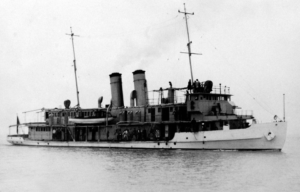
Origins as USS Guam (PG-43)

Initially commissioned as the USS Guam (PG-43), the gunboat was launched on May 28, 1927, in Shanghai, China, and officially entered service that December under the command of Lt. Robert K. Awtry. She was among six newly designed river gunboats intended to replace older patrol vessels on the Yangtze River.
In her early service, Guam’s primary mission was protecting American missionaries and other foreigners amid China’s turbulent political landscape. On July 4, 1930, she steamed upriver to Yochow and Chenglin to investigate reports of Americans taken by Communist forces. As the vessel approached Yochow, it came under rifle fire from the shore, tragically killing one crew member.
In addition to protection assignments, Guam carried out radio intelligence work, monitoring Japanese military activities in the region. By the late 1930s, as Japan tightened its grip on parts of China, her patrols became increasingly perilous, with Japanese warships regularly shadowing her movements.
The USS Wake (PR-3) is captured by the Imperial Japanese

In 1941, the USS Guam was renamed the USS Wake, as her former name was being used for a new battlecruiser.
In November 1941, Lt. Cmdr. Andrew Earl Harris was ordered to close the US Navy installation at Hankow and sail for Shanghai. On the 28th, he and most of his crew were transferred to gunboats and told to sail to the Philippines. On the same day, Lt. Cmdr. Columbus Darwin Smith was summoned by Adm. William Glassford and asked to take command of Wake.
Smith seemed to be the obvious choice for the position as an old “China hand” with years of experience in the Far East. He was also a member of the Shanghai Pilot’s Association, who assisted in guiding international shipping up the Yangtze River, toward the Whangpoo River and Shanghai. Furthermore, Smith was able to speak Mandarin and could get by in Japanese.
On November 30, 1941, Wake reached the Chinese coast. It was here that her crew was divided between two ships, the USS Luzon (PG-47) and Oahu (PR-6). The two vessels then set sail for Manila while a skeleton crew of around 14 reservists stayed aboard Wake to serve as a radio outlet for the handful of Marines and Consular force that remained. There were no docks, so the gunboat was stationed at an anchorage in the middle of the Whangpoo.
One week later, the Japanese attacked Pearl Harbor. Immediately after, they demanded that Wake’s crew surrender and quickly captured the gunboat. Smith was the first American taken prisoner by the Japanese. He and the crew were thrown into a prison camp near Shanghai, where US Marines and Navy sailors captured on Wake Island would also be imprisoned.
During the Second World War, Wake was the only American vessel captured by the enemy, intact.
The USS Wake (PR-3) enters service with the Imperial Japanese

By December 15, 1941, the USS Wake had been renamed IJN Tatara and assigned to the Sasebo Naval District. Tatara became part of the China Area Fleet within the Shanghai Base Force.
During World War II, the gunboat was targeted by Allied forces. In September 1945, Japanese forces in China formally surrendered, and Tatara was returned to the Americans. The U.S. then transferred Wake to the Chinese Nationalist Party, who renamed it the RCS Tai Yuan.
In 1949, the RCS Tai Yuan was captured by the People’s Republic of China and served with the Communist forces until the 1960s. No other U.S. Navy ship has since borne the name Wake, although a Casablanca-class escort carrier launched in 1943 was named USS Wake Island (CVE-65).
Fate of Lt. Cmdr. Columbus Darwin Smith

An interesting side story to the USS Wake‘s history involves Lt. Cmdr. Smith, who was taken prisoner by the Japanese after the attack on Pearl Harbor.
Smith escaped Japanese internment not once, but twice during a three-year period. In January 1942, he was moved to Woo Sung Prisoner of War Camp, where he met Cmdr. John Woolley of the British Royal Navy. In March of that year, Smith, Woolley and two others dug beneath the electric wiring surrounding the camp and escaped. However, only hours later, they were recaptured by Chinese soldiers working with the Japanese.
The escapees underwent brutal punishment at the hands of the Japanese for their escape attempt. They were taken to Ward Road Jail to be tried with desertion from the Imperial Japanese Army and put on trial before a military court. After the trial, they were thrown into solitary confinement for 52 days, all the while not knowing their fate.
Finally, they were taken back into the courtroom and Smith received a sentence of 10 years’ imprisonment.
Smith and Woolley were still determined to escape. The pair and a handful of other POWs made a rope from sheets and worked together to climb over a 25-foot-high wall. After successfully breaching the perimeter, they traveled over 700 miles on foot to the Chinese Nationalist Lines and were flown to freedom.