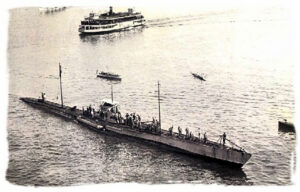
German U-boats after WWI

In 1919, just months after the guns of World War I fell silent, Europe began the long road to recovery. When the Armistice was signed, Germany was required to surrender its naval fleet to the Allies. This was only the beginning of what would become a punishing disarmament process. Under the Treaty of Versailles, Germany was stripped of its military strength and saddled with crushing reparations for the devastation caused by the war.
Rather than comply, the German Navy chose to scuttle most of its own fleet, defying the surrender conditions. But the prized U-boats—the cutting-edge submarines that had terrorized Allied shipping—were spared from scuttling and eventually seized by the British. At the time, Germany was at the forefront of submarine innovation, and these captured vessels represented a significant opportunity to study and display the technology of a fallen adversary.
The US saw U-boats as a way to fix some of their wartime debt

Following World War I, Britain took possession of 176 surrendered German U-boats, allocating many to Allied nations for study and experimentation. These transfers came with a strict requirement: after examination, the submarines were to be deliberately sunk in deep waters to prevent any chance of recovery.
Interest in keeping the U-boats in the United States was limited. Naval authorities largely viewed them as inferior to domestic submarine designs, and Britain was leading an international movement to outlaw submarine warfare entirely, given the immense destruction it had wrought during the conflict.
Still, some American leaders saw an opportunity. Confronted with enormous postwar debts, they devised a creative plan: transport several of the captured submarines across the country and display them to the public. By charging admission for these exhibitions, the government could satisfy popular curiosity while generating revenue to help pay down war bonds—a patriotic spectacle that also offered practical financial benefits.
UC-97

German submarine UC-97 was one of six German submarines transported from Europe to the United States after World War I. Classified as a Type UC III boat, it belonged to a smaller class of minelaying U-boats developed late in the war. These submarines carried six mine-laying tubes, three torpedo tubes, and a deck gun.
Although more than 100 Type UC III boats were originally planned, the war’s end halted production, and only 25 were completed. UC-97 was among that limited number. When it reached the United States, the public was told it had sunk seven ships—a claim intended to enhance its appeal. In reality, the submarine never saw combat, and the story was fabricated to make the exhibit more dramatic.
UC-97 toured the Great Lakes

She spent much of this time in New York City, attracting thousands of visitors wherever it went. Once she had served her use making money, the submarine began more tours as part of a recruitment drive.
She toured the Great Lakes visiting places like Milwaukee and Chicago, and once again pulled in huge crowds, attracting so many people that ports often struggled to cope with them. After her tour was over, she was completely stripped of anything even remotely useful and moored up on the Chicago River.
The empty hull sat there until 1921. In June of that year, UC-97, lacking engines for propulsion, was towed out into Lake Michigan to fulfill the original agreement of sinking it once it was no longer useful.
The sinking of UC-97

UC-97 was to be used as a floating target for the gunboat USS Wilmette in a highly publicized event. She was hit by a number of 4-inch rounds before quickly sinking to the bottom of the lake, to be forgotten for much of the century.
Attempts to locate the vessel in the 1960s and 1970s were thwarted by a clear lack of information about the submarine’s final moments. In 1992, UC-97 was finally discovered by A and T Recovery. Her location is not available to the public, but A and T Recovery have visited her multiple times since the discovery.