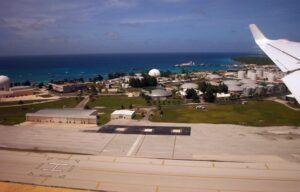
Naval Support Facility Diego Garcia

Naval Support Facility Diego Garcia is a highly secretive military base jointly operated by the United Kingdom and the United States in the Indian Ocean. Built in 1971, the base was established after the forced displacement of the island’s native inhabitants, known as the Chagossians. At first, the facility accommodated 20 deep-water logistics vessels, and later expanded with the addition of a naval airfield that was active from 1981 to 1987.
Despite its remote position, roughly 1,000 miles from India, Naval Support Facility Diego Garcia has played an important strategic role. During the Iraq War, it served as a key logistics hub. Before U.S. forces were able to set up bases within enemy territory, the island was an essential location for aircraft operations, including takeoffs and landings.
More recently, the site has become an important place for space surveillance, using the Ground-Based Electro-Optical Deep Space Surveillance system to monitor satellites and other objects in deep space.
Cheyenne Mountain Complex

US Army Garrison Kwajalein Atoll

During the Second World War, the US performed an amphibious landing on the island of Kwajalein and never left. There were Japanese troops stationed there who were either captured or killed. A secret military base was established there as the conflict drew to a close, acting as a staging area for Operation Downfall – the planned invasion of the Japanese homeland.
Instead of giving up the island when the war ended, the Americans stayed and established it as one of their command centers for nuclear testing in the Marshall Islands. As a result, much of the local population was pushed out, and those who remained worked in labor camps.
With the end of the Cold War, much of the nuclear testing was canceled, and the size of the US Army Garrison drastically shrank. That isn’t to say that they left completely, as there’s still a military presence on the island. In fact, the Americans have it leased until 2066.
At present, Kwajalein Atoll is home to the Space Fence radar, which is used to track space debris and satellites. It’s also one of five ground stations used to control GPS technology.
Yulin Naval Base

The facility features both above-ground and underground submarine docks. Satellite images have captured weapons being loaded onto submarines, but the exact types and quantities remain unknown. While the base also accommodates warships, its primary purpose is to house nuclear submarines, which access the site through a semi-submerged tunnel carved into the mountainside.
Porton Down

Porton Down, still in operation today, is the world’s oldest chemical warfare research facility. It’s also incredibly controversial. Located in Wiltshire, England, Porton Down began as the War Department Experimental Station in 1916 and opened in response to the German use of chemical weapons in World War I. Those employed there were tasked with researching possible solutions, as well as improving respirators.
Although it remained open during the interwar period, this secret military base was, again, fully staffed during the Second World War, when the research focused on studying newly-discovered German nerve agents and creating British biological weapons. The main criticism of the establishment was that the tests all took place on human subjects – so-called “volunteers” – who were conned into participating. Many died or suffered long-term health consequences from the tests.
Still in operation, Porton Down holds samples of many deadly pathogens, including anthrax, the Black Plague and Ebola. Those who work there are still active in analyzing mysterious chemicals, viruses and pathogens.
Pine Gap

This secret military base, located in the Australian Outback, is certainly a sight to behold, with its large white spheres. It’s jointly operated by Australian and American forces – including the Central Intelligence Agency (CIA), National Security Agency (NSA) and the National Reconnaissance Office.
Despite its remote location, Pine Gap plays an extremely important role in international reconnaissance and intelligence. It’s the control center for many spy satellites, which travel over Russia, the Middle East and China. In fact, the site was chosen specifically because it’s too far away for these signals to be intercepted by spy ships.
Pine Gap was opened in 1970 and initially designed to focus on detecting nuclear threats and Soviet missiles during the Cold War. It has now moved toward supporting the US military by detecting airstrikes, as well as intelligence and data gathering.
Volkel Air Base

There are only three places in the world that don’t show up on Google Maps, including the last entry on our list of secret military bases: Volkel Air Base. It’s not exactly clear why it can’t be found, especially as it’s easily located by those living in the area. The most popular theory is that it has stored weapons for the US Air Force since the Cold War. This hasn’t been commented on by the Dutch Minister of Defence, but leaked documents indicate that these types of weapons are in the Netherlands.
Volkel Air Base was actually created by the occupying Germans in 1940, first for use as a diversionary base for Allied bombings, and, later, as a fully operational Luftwaffe base. Following Allied attacks on the airfield as part of Operation Market Garden, the Germans were no longer able to use it. The Royal Air Force (RAF) briefly did, however, after they gained control of the area.
More from us: Pave Low: Converting Search and Rescue Helicopters for Use In Special Ops
In 1949, the base was used by the Dutch Naval Aviation Service (MLD) for training, before being restored to a functional airfield by the Royal Netherlands Air Force (FNLAF) a year later. It’s still in use today, and may or may not have nuclear weapons.