The Swamp Ghost ultimately became much more than a recovered wartime aircraft; it emerged as a powerful reminder of World War II’s lasting legacy. Investigations established that the Boeing B-17E Flying Fortress had crash-landed during a 1942 mission in the Pacific, most likely due to battle damage or a major mechanical failure. Despite spending decades abandoned in a remote swamp, significant portions of the aircraft—including much of its fuselage and wings—remained remarkably intact, offering a haunting glimpse into its wartime history.
Researchers examining the wreck discovered artifacts connected to the bomber’s final mission, including personal effects, operational documents, and pieces of equipment that had been preserved unusually well by the swamp environment. The aircraft’s isolated location and striking state of preservation served as a vivid reminder of the sacrifices made during the war. Once regarded largely as a local legend, the Swamp Ghost eventually became both a memorial to those who served and a tangible link to the often-overlooked wartime history of Papua New Guinea.
The crew survived a death-defying crash
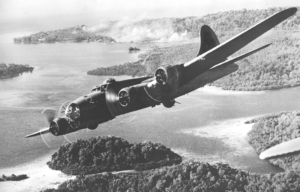
Boeing B-17E Flying Fortress. (Photo Credit: U.S. Air Force / Wikimedia Commons / Public Domain)
On February 23, 1942, just months after the Japanese attack on Pearl Harbor, Capt. Frederick C. Eaton Jr. flew a B-17E Flying Fortress over Rabaul, Papua New Guinea, which Japanese forces had recently overtaken. During the mission, the bomber was struck, damaging a wing and causing a critical fuel leak, making it impossible for the crew to return to their base in Port Moresby.
With no other options, Eaton attempted an emergency landing in what appeared to be a wheat field. The crew survived the impact, only to quickly realize they had landed in a crocodile-infested swamp. Despite the dangerous surroundings, they managed to escape and were rescued by local villagers, who treated them for malaria. Once they recovered, the crew continued their service through the remainder of World War II.
The legend of the “Swamp Ghost”
“Swamp Ghost” on display at the Pearl Harbor Aviation Museum. (Photo Credit: Pacific Aviation Museum / Wikimedia Commons CC BY 2.0)
Over time, the Swamp Ghost became more than the remains of a World War II bomber. Resting in the isolated swamps of Papua New Guinea, the aircraft developed an almost mythical reputation. Cut off from the modern world, it appeared frozen in time, serving as a historical artifact, a memorial, and a continuing source of fascination. Vegetation gradually closed in around the site, mud covered portions of the fuselage, and stagnant water gathered inside parts of the wreck, leaving the aircraft seemingly caught between the past and the present.
Stories of bad luck, local folklore, and superstition eventually became associated with the Swamp Ghost, deepening its mystique and attracting historians, explorers, and aviation enthusiasts. Amid dense vegetation, quiet surroundings, and the slow passage of time, the bomber came to represent more than a remarkably preserved wartime relic. It endured as a reminder of courage and sacrifice, as well as an example of how real events from history can slowly take on the qualities of legend.
Salvagers spotted the B-17E Flying Fortress in the jungle
Hull of the “Swamp Ghost” on display at the Planes of Fame Air Museum. (Photo Credit: Tomás Del Coro / Wikimedia Commons CC BY 2.0)
When the Australian airmen spotted the B-17E in 1972, they were astonished by their discovery. The wreck was in remarkable condition, with thermoses filled with coffee poured by the original crew still intact!
In the 1980s, following news of the find, renowned aircraft salvager Fred Hagan and his partner, David Tallichet, embarked on a mission to locate and salvage the wreck. They were astonished to see that the “Swamp Ghost” remained in such excellent shape. Although most of the weapons and mechanics had been taken by locals, the interior was still impressive.
Hagan and Tallichet initiated the reconstruction of the heavy bomber to ensure it was strong enough for transport. However, setbacks delayed their efforts for several years. Ultimately, in 2006, the salvage mission was completed, except for one last hurdle: locals were resistant to its removal. After a ceremony to honor the spirits of the swamp, the aircraft was finally allowed to depart its resting place for the first time in 65 years.
Once it was fully restored, the “Swamp Ghost” was displayed at a ceremony in Long Beach, California, attended by many family members of the original crew. It has since been permanently moved to the Pearl Harbor Aviation Museum in Hawaii, where it’s undergoing restoration.