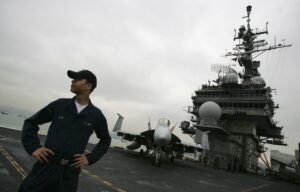
In May 2022, USS Kitty Hawk (CV-63) arrived in Brownsville for the final time, marking the end of a remarkable naval career that spanned nearly sixty years. Commissioned in 1961, the carrier served across multiple oceans and through several major periods of American military history, becoming one of the most recognizable ships in the U.S. fleet. Built at a cost of $264 million—an amount equal to roughly $2.5 billion today—she reflected both the scale of American naval engineering and the strategic priorities of the Cold War.
Though she spent decades as a centerpiece of American sea power, Kitty Hawk’s final chapter came quietly. In 2021, the U.S. Navy sold the carrier to a scrapping company for a symbolic price of just one cent, disappointing veterans, historians, and supporters who had hoped to see her preserved as a museum ship. While the vessel itself has now been dismantled, the legacy of Kitty Hawk endures through the generations of sailors who served aboard her and through the lasting place she holds in the history of the U.S. Navy.
Captivating military personnel and civilians alike

Service during the Vietnam War

During the Vietnam War, the USS Kitty Hawk served in Southeast Asia and was later upgraded to improve her performance as a multi-role aircraft carrier. In the 1970s, she operated throughout the Western Pacific, contributing to humanitarian missions like rescuing Vietnamese refugees and providing support after the assassination of South Korean President Park Chung-hee. She also deployed to the Arabian Sea during the Iran Hostage Crisis.
For the rest of her career, Kitty Hawk remained active in military operations across the Middle East and the Pacific.
Weapons equipped by the USS Kitty Hawk (CV-63)

Beyond her combat prowess, the Kitty Hawk hosted several notable guests, including U.S. President John F. Kennedy, Nancy Sinatra, and author John Steinbeck. She also made a memorable appearance in Hollywood, serving as the backdrop for Disney’s 1966 film Lt. Robin Crusoe, U.S.N.
In a historic achievement, the Kitty Hawk became the first aircraft carrier to receive the Presidential Unit Citation in December 1967, in recognition of her outstanding service during the Vietnam War, especially her role in the Tet Offensive.
Sold down the river

The U.S. Navy announced in 2005 that the nuclear-powered aircraft carrier USS George Washington (CVN-73) would succeed USS Kitty Hawk as the forward-deployed carrier at United States Fleet Activities Yokosuka in Japan.
USS Kitty Hawk entered the decommissioning process in 2008 and was formally retired in 2019 at Bremerton, Washington. More than 2,000 people assembled in the carrier’s hangar bay for the retirement ceremony, which paid tribute to the distinguished service of what was then the Navy’s oldest active warship.
Veterans tried to save her

With the future of USS Kitty Hawk (CV-63) uncertain, the USS Kitty Hawk Veterans Association led an effort to preserve the carrier and turn it into a museum ship. The campaign raised roughly $5 million, reflecting the deep connection veterans and supporters still felt toward the vessel. Despite those efforts, the Navy declined the proposal and proceeded with plans to scrap the ship. In October 2021, Kitty Hawk and USS John F. Kennedy (CV-67) were each sold to International Shipbreaking Limited for the symbolic price of one cent each.
Kitty Hawk arrived in Brownsville, Texas, in May 2022, and dismantling began soon afterward. The scrapping process was expected to take between five and ten years and cost an estimated $750 million, marking a somber end for one of the best-known aircraft carriers in U.S. Navy history.