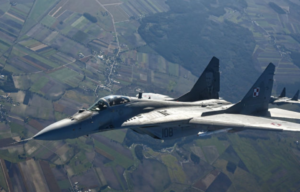
The Mikoyan MiG-29, introduced in the 1980s, is a Soviet-designed fighter aircraft built mainly for air superiority missions. Known for its speed, agility, and combat performance, the MiG-29 appeared during the late Cold War as a response to advanced American aircraft like the F-16 Fighting Falcon and the F-15 Eagle.
One of the Fulcrum’s most distinctive features is its twin-engine design, which gives it strong thrust and excellent maneuverability. This allowed it to outperform earlier aircraft like the F-14 Tomcat in some flight conditions while still remaining competitive with newer aircraft such as the F/A-18 Hornet. Because of this, the MiG-29 gained a reputation as a highly capable and respected aircraft in air combat.
Development of the Mikoyan MiG-29 Fulcrum

As the Vietnam War continued to rage on in the mid-to-late 1960s, the US Air Force knew it needed to develop a new fighter jet to combat the Mikoyan-Gurevich MiG-15s being supplied to the North Vietnamese by the Soviet Union. In response to what became the McDonnell Douglas F-15 Eagle, the USSR decided to develop an even more high-tech aircraft capable of a long range at Mach 2+ speed, carrying a variety of heavy armaments and complex maneuvers.
These requirements changed when officials determined that the newest Soviet jet needed to have much different specifications, with the biggest change coming in the decision to make the aircraft lightweight.
After years of development and design, what became known as the MiG-29 Fulcrum took to the skies in October 1977, with the aircraft officially entering service with the Soviet Air Forces in August 1983. Still active to this day, a number of upgrades have been applied to the original specs, resulting in quite a few, more advanced variants, including the MiG-29K Fulcrum-D and the MiG-29M Fulcrum-E.
Mikoyan MiG-29 Fulcrum specs

Operational service with the Soviet Union (and, later, Russia)

The MiG-29 Fulcrum immediately proved itself to be a superior aircraft upon entering service with the Soviet Union. Capable of taking on virtually any enemy in a dogfight, it continued to serve with the Russian Air Force following the collapse of the USSR, with approximately 600 (original and variants) still being flown by the service.
Despite being several decades old, the MiG-29 hasn’t really seen that much combat with the Russians, with the aircraft largely being flown at airshows, with some crashes reported. That being said, the SMT variant was deployed as part of the Syrian Civil War in 2017, conducting bombing missions and escort duties.
Outside of Russia, another Soviet country to equip the MiG-29 is Ukraine, with whom it has seen much more action. In 2014, the Ukrainian Air Force deployed many during the Russian invasion of Crimea and the War in Donbas. More recently, they’ve taken to the skies as part of the Russo-Ukrainian War, making them a target of Russian missile strikes.
Exported to a number of air forces across the world

Because it combined advanced technology and high maneuverability, the MiG-29 Fulcrum became one of Russia’s most successful fighter exports. Numerous nations added the aircraft to their air forces, with East Germany among the first customers after purchasing 24 MiG-29s in the mid-1980s. Following the collapse of the Berlin Wall, the aircraft were absorbed into the West German Luftwaffe, where they remained in service until the final MiG-29 was transferred from Germany in 2004.
India also became a key operator, becoming both the first country outside the Warsaw Pact and the first international purchaser to acquire the MiG-29. The Indian Air Force placed an order for 44 aircraft in 1984 and later expanded its fleet. The fighters saw combat during the Kargil War before undergoing modernization programs that introduced upgraded avionics and more advanced weapon systems.
The MiG-29 continues to serve with several air forces today, including those of North Korea, India, Iran, Cuba, Bulgaria, Poland, and Peru.
Enduring legacy of the MiG-29 Fulcrum

More from us: The Magic Engineering Behind Why Early Fighters Didn’t Shoot Their Own Propellers
The Mikoyan MiG-35 is a direct development of the Mikoyan MiG-29. It keeps the proven design of the MiG-29 while adding major technological upgrades. The MiG-35 first flew in 2016 and entered service with the Russian Air Force in 2019. It features improved avionics, better maneuverability, and more advanced weapons systems.
These upgrades make the MiG-35 a more flexible and powerful multirole fighter, capable of handling the demands of modern air combat.