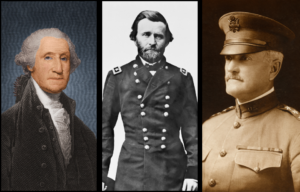
John J. Pershing’s slow climb up the US military hierarchy

Long before he became a 6-star general, John J. Pershing attended the United States Military Academy West Point. Following his graduation, he spent the first years of his military career fighting the Apache and Lakota Sioux in New Mexico, as well as at other Western outposts. While in Montana, he was promoted to first lieutenant of the 10th Cavalry Regiment.
In 1898, Pershing and the 10th Cavalry traveled to Cuba to fight in the Spanish-American War. He fought in the battles of Santiago de Cuba and San Juan Hill, earning himself a Silver Citation Star that was later upgraded to the Silver Star and a promotion to captain. After heading to the Philippines to lead repeated efforts to subdue the Moro Rebellion, he earned yet another promotion, this time to brigadier general.
In 1916, US President Woodrow Wilson had Pershing lead an expedition in Mexico to search for revolutionary Francisco “Pancho” Villa, who’d recently raided Columbus, New Mexico. The search included approximately 10,000 soldiers and lasted nearly a year. However, despite Pershing and his men’s efforts, including the defeat of Villa’s forces, the man remained at large.
John J. Pershing refused to sacrifice American lives

When the U.S. entered World War I, John J. Pershing’s career hit its defining moment. He was named General of the Armies, a rank often viewed as the U.S. military’s highest possible honor—roughly equivalent to a six-star general. President Woodrow Wilson tapped him to command the American Expeditionary Force (AEF) in Europe and build a modern American army presence from the ground up.
To meet this challenge, Pershing drafted the General Organization Report, a bold plan to raise one million troops by 1918 and expand to three million the following year. He focused on transforming raw recruits into a capable, cohesive fighting force.
Pershing clashed with Allied leaders early on. Both the British and French urged him to integrate American troops into their battle-worn units, hoping to bolster their own ranks. But Pershing stood firm. He famously dismissed the idea, saying it would be like “pouring new wine into old bottles.” He was determined that U.S. forces would fight under an independent American command—not as backup for foreign armies—and would not be sacrificed as mere reinforcements.
Promotion to six-star general

Upon returning to the United States, John J. Pershing was celebrated for his leadership during World War I and became the first person to hold the rank of six-star general. This newly established rank, titled “General of the Armies of the United States,” initially had no official insignia. Pershing chose to create one himself, selecting gold stars instead of the silver stars worn by other generals. He retained this rank for the remainder of his military career. According to the US Army Center of Military History,, Pershing retired on September 13, 1924, yet continued to hold the six-star designation until his death in 1948.
Trouble with George Washington’s military rank

A posthumous promotion to six-star general

When George Washington received the rank of lieutenant general, the formal classifications of four-star, five-star, and six-star generals did not yet exist. As these higher ranks were later introduced—spanning conflicts such as the American Civil War, World War I, and World War II—Congress determined it would be inappropriate for Washington, the nation’s first president and foundational military leader, to be outranked by subsequent officers.
To remedy this, on March 13, 1978, Congress passed legislation posthumously promoting Washington to General of the Armies of the United States, a position equivalent to six stars, with the promotion retroactive to July 4, 1976. The law explicitly stated that “no officer of the United States Army should outrank Lieutenant General George Washington on the Army list.”
Although General John J. Pershing had previously held the same title, his standing did not supersede Washington’s, ensuring the first president retained ultimate precedence.
Ulysses S. Grant showed military promise from a young age

Prior to becoming the 18th president of the US, Ulysses S. Grant had dedicated his life to military service, attending West Point on the recommendation of Democratic congressman Thomas L. Hamer and, later, serving at the Jefferson Barracks, Missouri, under the command of Col. Stephen W. Kearny.
Grant got his first taste of combat during the Mexican-American War, participating in the Battle of Palo Alto and several other engagements against the Mexican forces. The conflict allowed him to show his prowess on the battlefield and it didn’t take very long for higher-ups in the military to see the soldier’s potential.
Leading the Union forces to victory during the American Civil War

Fast forward to the American Civil War, where Ulysses S. Grant solidified his place in history. Called up by Illinois Gov. Richard Yates to lead the less-than-proper 21st Illinois Volunteer Infantry Regiment, he quickly showcased his ability to whip troops into shape. Before long, he’d been named brigadier general of volunteers (later to be major).
Over the course of the conflict, Grant led his men through many high-profile engagements, including attacks on Fort Henry and Fort Donelson and the casualty-heavy Battle of Shiloh. After skillfully succeeding in splitting the Confederate forces in two with the Vicksburg Campaign, the military leader set his sights on Chattanooga, followed by the controversial Battle of Cold Harbor.
By the Confederate surrender in 1865, Grant had risen to commander of the Army. He subsequently ran for the presidency and was sworn in, in 1869, serving two terms.
A long-overdue promotion to six-star general

In December 2022, on the 200th anniversary of his birth, Ulysses S. Grant was posthumously promoted to the rank of six-star general. This was made possible by a provision in the 2023 National Defense Authorization Act, which was approved by the US Congress and signed into law by President Joe Biden, much to the satisfaction of military enthusiasts.
More from us: Battle of Tannenberg: Annihilation of the Russian Second Army
With the promotion, Grant became the third individual to receive the title of General of the Armies of the United States. It’s unknown if we’ll ever see a fourth be promoted to the prestigious rank.