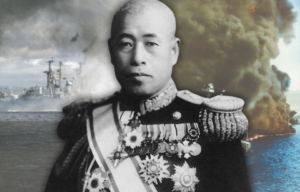
Photo Credit: 1. Photo12 / Universal Images Group / Getty Images 2. MPI / Getty Images 3. Unknown Author / National Diet Library / Wikimedia Commons / Public Domain
Isoroku Yamamoto, one of Japan’s foremost naval strategists, viewed the prospect of war with the United States far differently than many of his counterparts within the Imperial Japanese Navy. Having spent considerable time in America—including serving as a naval attaché in Washington, D.C.—he gained firsthand insight into the nation’s enormous industrial power, technological capabilities, and ability to rapidly mobilize for war. Those experiences made him deeply cautious about provoking the United States, concerns he repeatedly voiced despite being largely ignored by many within Japan’s leadership.
By late 1941, however, Yamamoto found himself with little strategic flexibility. He was assigned to organize and oversee the Attack on Pearl Harbor, believing that Japan’s only chance lay in delivering a devastating blow to the U.S. Pacific Fleet at the outset of the conflict. Drawing on his understanding of American strength, he hoped such an attack might provide Japan with a temporary strategic advantage and enough time to consolidate its position in the Pacific. Even so, Yamamoto remained aware of the enormous gamble involved, recognizing that war against a nation with the United States’ industrial and military capacity could ultimately prove impossible for Japan to sustain.
Isoroku Yamamoto was born Isoroku Takano in 1884 and eventually became one of the Imperial Japanese Navy’s most prominent officers. His father was a relatively low-ranking samurai who was 56 at the time of his birth. In 1916, Takano was adopted by the respected Yamamoto family, which had no male heir. Such adoptions were a recognized practice in Japan for families seeking to continue their name and lineage. He subsequently adopted the Yamamoto surname and became part of a more distinguished samurai family.
After completing his studies at the Imperial Japanese Naval Academy in 1904, Yamamoto entered naval service and fought in the Russo-Japanese War. During the Battle of Tsushima, he was wounded and lost the index and middle fingers of his left hand. His wartime service earned him recognition and helped propel his career forward within the Imperial Japanese Navy.
Yamamoto attained the rank of lieutenant commander in 1916 and was promoted to commander three years later. His steady rise through the ranks further established him as an increasingly important figure within Japan’s naval leadership.
Experience in the US, rivalry with the Japanese Army
Yamamoto Isoroku, Admiral and Commander-in-chief of the Japanese Fleet, receives a medal, 1940. (Photo Credit: Bettmann / Getty Images)
Yamamoto spent a fair amount of time in the US during the 1920s and ’30s. He was a student at Harvard University from 1919-21. He also had two postings as a naval attaché in America, where he learned to speak fluent English. Yamamoto created controversy in 1937 when he apologized to the US for Japan’s 1937 bombing of the gunboat USS Panay.
The Imperial Japanese Army was significantly more aggressive and pro-war than its Navy, and was angered by Yamamoto’s opposition to a pact with Germany and Italy. Following his apology to the US, he received death threats, to which he said:
“To die for Emperor and Nation is the highest hope of a military man. After a brave hard fight the blossoms are scattered on the fighting field. But if a person wants to take a life instead, still the fighting man will go to eternity for Emperor and country. One man’s life or death is a matter of no importance. All that matters is the Empire.”
Attack on Pearl Harbor
USS West Virginia (BB-48) and Tennessee (BB-43) on fire during the Japanese attack on Pearl Harbor. (Photo Credit: US Navy / Interim Archives / Getty Images)
Isoroku Yamamoto advanced through the ranks of the Imperial Japanese Navy due to a blend of intellectual rigor, disciplined command ability, and an unusually modern understanding of naval warfare. By November 1940, he had reached the rank of admiral, earning both institutional respect within the navy and trust from elements of the Imperial court, even as his progressive strategic outlook often clashed with more conservative factions within Japan’s military leadership.
Privately, Yamamoto remained skeptical about the prospect of war with the United States. He understood that Japan lacked the industrial base necessary to compete with American production capacity, and he believed that a drawn-out conflict would likely end in Japan’s disadvantage. This assessment heavily shaped his involvement in planning the attack on Pearl Harbor. If war could not be avoided, he concluded that Japan’s best chance lay in delivering a swift and crippling strike aimed at the U.S. Pacific Fleet in order to delay American retaliation.
In the immediate aftermath, the attack achieved notable tactical success. Multiple U.S. battleships were sunk or heavily damaged, and nearly 200 aircraft were destroyed or rendered inoperable within hours. Strategically, however, the results proved deeply counterproductive. Instead of weakening the United States, the attack galvanized public opinion and activated the full scale of American industrial and military power. In hindsight, Yamamoto’s earlier warnings proved strikingly accurate, as the very conflict he had cautioned against ultimately contributed to Japan’s defeat.
Battle of Midway and Yamamoto’s death
Artist’s impression of the Battle of Midway, 1942. (Photo Credit: Hulton Archive / Getty Images)
Despite initial Japanese successes after Pearl Harbor, Yamamoto advocated for continued attacks on the US Fleet. The Battle of Midway in June 1942 was intended to maintain Japanese offensive momentum. However, before the operation, US forces were able to break the Japanese Naval Code. This intelligence allowed Admiral Chester Nimitz to prepare effectively, resulting in a decisive US victory that shifted the course of the war.
Following setbacks and defeats at Guadalcanal and Midway, Yamamoto embarked on a morale-building tour for his forces. US intelligence intercepted and decrypted details of his itinerary, enabling American pilots to shoot down his plane on April 18, 1943. Posthumously, Yamamoto was honored with the title of Marshal Admiral and awarded the Order of the Chrysanthemum by Japan. Additionally, he received Germany’s Knight’s Cross of the Iron Cross.
Yamamoto’s legacy
Isoroku Yamamoto. (Photo Credit: National Diet Library / Wikimedia Commons / Public Domain)
Yamamoto has been featured in a number of films about Pearl Harbor and World War II. Moviegoers may remember him for the Tora! Tora! Tora! (1970) line that he may or may not have uttered: “I fear that all we have done is to awaken a sleeping giant and fill him with a terrible resolve.” The line was also referenced in 2001’s Pearl Harbor.
Historians, however, are not sure he ever actually made this observation.
Yamamoto was also portrayed by legendary actor, Toshiro Mifune, in three separate films: Rengo Kantai Ichokan Yamamoto Isoroku (1968), Gekido no showashi ‘Gunbatsu’ (1970), and Midway (1976).