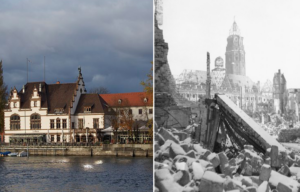
Konstanz is a historic city

Following the unification of Germany in 1871, Konstanz became part of the newly established German Empire. In the aftermath of World War I, the city was incorporated into the Republic of Baden, where it operated under the governmental framework of the Weimar Republic.
Air raids during World War II
During the Second World War, many European cities endured air raids, often referred to as strategic bombing campaigns. These operations focused on important targets such as densely populated urban areas, transportation networks, and industrial facilities with the intention of weakening the enemy’s ability to fight.
Most bombing missions were carried out under the cover of darkness and were coordinated with ground offensives to maximize their impact. Their primary purpose was to disrupt enemy operations as extensively as possible. As the war continued, the campaigns proved reasonably effective, and the frequency of these bombing raids increased.

Germany concentrated its bombing campaign mainly on England, directing attacks at London and key port cities. Allied bombing operations, however, inflicted far greater destruction across Germany, devastating urban centers including Hamburg and Dresden. One reason for this disparity was that Allied aircraft could carry heavier bomb loads than those operated by the Luftwaffe.
Konstanz refuses to go dark

Konstanz, however, took a different approach from many other German cities and left its lights on. Just across the border, the Swiss city of Kreuzlingen remained illuminated because the country’s neutrality, Switzerland was not subject to wartime blackout requirements. Officials in Konstanz hoped Allied aircrews would see the lights and assume the German city was part of Switzerland.
The strategy proved effective. American aircrews reportedly mistook the illuminated area for neutral Swiss territory, and Konstanz escaped the large-scale bombing that devastated many other German cities. As a result, much of its historic architecture survived the war, later becoming an important part of the city’s tourism appeal.
Konstanz contributed to the war effort in Germany
Looking back, the Allies probably wished they hadn’t been fooled by the tactic, as Konstanz played an active role in the German war effort. The city produced parts for the German arsenal, all of which were used against the Allies.
Konstanz manufactured radar parts for German submarines, as well as for guns. Schwarzwald Flugzeugbau GmbH developed its flying torpedoes at a facility in the city, while aircraft manufacturer Dornier transferred a portion of its production there after the bombing of Friedrichshafen.

More from us: Bruno Mussolini: How His Early Death Impacted His Father
As well, Konstanz actively participated in the deportation of Jewish citizens from Germany. In October 1940, the last were sent to the Gurs internment camp in southwestern France. Those still alive in August 1943 are believed to have died at either Auschwitz or Sobibór.