James Earl Jones’ early life

Service with the US Army

James Earl Jones once considered a future in medicine but quickly recognized it wasn’t the right fit. He shifted his focus to the University of Michigan’s School of Music, Theatre, and Dance. During this time, with the Korean War still underway, Jones expected to be drafted and decided to chase his passion for acting before military service called.
While awaiting orders, he took a part-time job as a stagehand at a local theater. In mid-1953, shortly after the war’s end, Jones was commissioned as an officer and sent to Fort Benning, Georgia. There, he completed the Infantry Officers Basic Course and attended the challenging U.S. Army Ranger School. Assigned to the 38th Regiment Combat Team’s Headquarters Company, he quickly assumed a leadership role within his battalion, which was stationed in Colorado’s harsh Rocky Mountains for training.
Looking back, Jones described his experience: “I took to the physical challenge, so much so that I wanted to stay there, testing myself in that awesome environment, mastering the skills of survival. I loved the austere beauty of the mountains and the exhilaration of the weather and the altitude. I didn’t mind the rigors of the work or the pioneer-like existence. I thought it was a good life.”
Although he rose to first lieutenant, Jones realized his true calling was acting, following in the footsteps of his father, Robert Earl Jones. Even with a promising military career ahead, his commanding officer supported his decision to pursue the arts, reassuring him that the Army would welcome him back if acting didn’t pan out.
James Earl Jones’ successful acting career

In the mid-1950s, James Earl Jones moved to New York City to pursue acting, taking a job as a janitor to support himself while chasing his dream. Before relocating, he had already performed in plays back home, including a standout performance as Othello. In New York, he continued to land major stage roles and soon earned a reputation as one of the finest Shakespearean actors of his generation.
He made his Broadway debut in 1957 and landed his first film role in 1964 in Stanley Kubrick’s Dr. Strangelove or: How I Learned to Stop Worrying and Love the Bomb. Over the years, he shared the screen and stage with major stars like Richard Burton and Elizabeth Taylor.
In 1970, Jones made history when he was nominated for an Academy Award for his powerful role in The Great White Hope, becoming just the second Black actor ever nominated for Best Actor.
Star Wars

In 1977, James Earl Jones appeared in one of his most iconic roles, even though he insisted on being uncredited for it. He played the voice of Darth Vader in George Lucas‘ Star Wars: A New Hope. Vader’s character was physically played by David Prowse, with Jones’ voice dubbed over. He reprised the role in the other two films within the trilogy, The Empire Strikes Back (1980) and Return of the Jedi (1983).
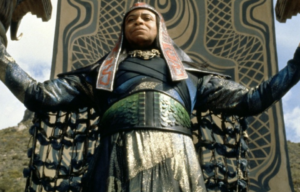
His iconic voice also appeared in animated classics like The Simpsons (1989-present) and The Lion King (1994), as well as full-fledged roles in films like The Hunt For Red October (1990) and Conan the Barbarian (1982).
Awards and accolades

In 1992, President George H.W. Bush awarded James Earl Jones the National Medal of the Arts. Years later, President George W. Bush also awarded him the Kennedy Center Honors and the Screen Actors Guild Life Achievement Award. Jones also achieved the prestigious “EGOT” title, meaning he received all four major Hollywood awards: an Emmy, Grammy, Oscar and Tony Award – although his Oscar was honorarily awarded.
More from us: Henry Fonda Served In the US Navy During WWII – He Didn’t Want a ‘Be a Fake In a War Studio’
On September 9, 2024, at the age of 93, James Earl Jones passed away at his Duchess County, New York, home. Up until the end, he continued to look back fondly on his time in the US Army.