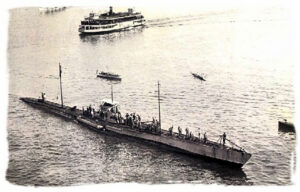

In 1919, just months after the guns of World War I fell silent, Europe began the long road to recovery. When the Armistice was signed, Germany was required to surrender its naval fleet to the Allies. This was only the beginning of what would become a punishing disarmament process. Under the Treaty of Versailles, Germany was stripped of its military strength and saddled with crushing reparations for the devastation caused by the war.
Rather than comply, the German Navy chose to scuttle most of its own fleet, defying the surrender conditions. But the prized U-boats—the cutting-edge submarines that had terrorized Allied shipping—were spared from scuttling and eventually seized by the British. At the time, Germany was at the forefront of submarine innovation, and these captured vessels represented a significant opportunity to study and display the technology of a fallen adversary.
The US saw U-boats as a way to fix some of their wartime debt

After World War I, Britain acquired 176 surrendered German U-boats and distributed many of them to Allied nations for study and testing. These transfers came with a clear condition: once examined, the submarines were to be intentionally scuttled in deep water to ensure they could not be recovered or reused.
In the United States, interest in retaining the U-boats was limited. Naval officials generally regarded them as inferior to American submarine designs, and Britain was also spearheading efforts to ban submarine warfare altogether due to the devastation it had caused during the war.
However, some American policymakers saw a different opportunity. Facing substantial postwar debt, they proposed a novel solution: transporting several of the captured submarines across the country and showcasing them to the public. Charging admission for these displays allowed the government to capitalize on public curiosity while also raising funds to help repay war bonds—turning former weapons of war into a patriotic and profitable exhibition.
UC-97

UC-97 toured the Great Lakes

She spent a large portion of this period in New York City, drawing thousands of spectators everywhere she appeared. After she had fulfilled her role as a profitable attraction, the submarine embarked on another series of tours as part of a naval recruitment campaign.
Her journey took her across the Great Lakes to cities including Milwaukee and Chicago, where enormous crowds gathered once again. Attendance was so high that many ports struggled to accommodate the influx of visitors. When the tour concluded, everything of potential value was removed from the vessel, and she was tied up along the Chicago River.
The stripped-down hull remained there until 1921. In June of that year, UC-97, which no longer had engines and could not move under her own power, was towed into Lake Michigan to complete the original plan of sinking the submarine once she had outlived her usefulness.
The sinking of UC-97

UC-97 was to be used as a floating target for the gunboat USS Wilmette in a highly publicized event. She was hit by several 4-inch rounds before quickly sinking to the bottom of the lake, to be forgotten for much of the century.
Attempts to locate the vessel in the 1960s and 1970s were thwarted by a clear lack of information about the submarine’s final moments. In 1992, UC-97 was finally discovered by A and T Recovery. Her location is not available to the public, but A and T Recovery have visited her multiple times since the discovery.