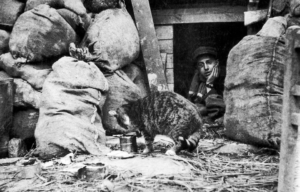
During World War I, cats served a purpose that went well beyond companionship. Found throughout trenches, camps, and supply depots, they were valued for their ability to control rats and mice, which posed constant problems by consuming food stores, contaminating supplies, and damaging equipment.
At the same time, their presence offered something less tangible but equally important. In the difficult daily reality of war, cats provided soldiers with moments of comfort and familiarity. Amid the mud, exhaustion, and constant strain of trench life, caring for and spending time with these animals gave many troops a brief sense of normalcy and emotional relief.
500,000 cats served in the trenches of World War I

It’s estimated 500,000 cats were dispatched to the trenches of Europe during World War I. They were tasked with killing the (oftentimes massive) rats that came to infest all fronts of the conflict, but they also had a secondary job: gas detection.
Chemical warfare played a major role in World War I

The conflict was the first time large-scale chemical warfare was utilized, and the near-odorless and colorless gas was incredibly dangerous. If it didn’t kill a soldier, it left him with permanent ill effects that caused medical issues later in life.
‘Canary in a coal mine’

To ensure the safety of troops on the front, Britain sent 500 cats to serve as their version of a “canary in a coal mine.”
The felines succumbed to the effects of gas faster than their human counterparts, providing enough warning for soldiers to grab their gas masks and seek shelter.
Cats served as messengers

A rather interesting use for cats during World War I was relaying messages between the lines. This is most notable during the Christmas Truce of 1914, when Allied and German troops sent messages to each other by tucking notes in their feline friends’ collars.
Paranoia arose as a result of using cats as messengers

Unfortunately, this approach led to growing paranoia, as demonstrated by the 1915 death of Felix the cat.
After a British intelligence report claimed that two cats and a dog had been spotted moving along enemy lines, officials became convinced the animals might be serving a suspicious purpose. Believing the threat was too serious to ignore, a French general had Felix captured and ultimately condemned him to death for treason.
Cats served as morale boosters

Cats did more than serve near the front—they also helped lift the morale of the soldiers. Many became unofficial mascots for their regiments, with troops frequently giving them some of their rations. During quiet breaks between battles, soldiers often unwound in their quarters by spending time with their feline companions.
Pitouchi: The hero cat of the Belgian Army

One of the more famous cats of World War I was Pitouchi, the adopted friend of Lt. Lekeux. After nursing the orphaned kitten back to health, Lekeux brought him everywhere, including near the German front. It was there that Pitouchi saved his friend’s skin, according to author Susan Bulanda.
Sketching enemy trenches

Pitouchi jumped into action

Pest patrol was an important job aboard warships

Having cats on ships has long been a common practice in maritime life, largely because of their strong instinct for hunting rodents. At sea, where supplies are limited, protecting food stores from rats and mice becomes a critical concern.
This also ties into the wider dangers posed by vermin, which can spread disease and damage essential materials like rope and rigging. During World War I, cats therefore played a practical role aboard ships by helping control infestations, indirectly supporting the health and safety of those on board.
Cats were a symbol of good luck on the high seas

In addition to their work in the pest control department, many sailors believed cats were a symbol of good luck, with the more superstitious thinking they had the ability to protect vessels from encountering hazardous weather, which isn’t exactly all that untrue. Felines are actually able to detect even the slightest change in weather, thanks to the sensitivity of their inner ears.
Sailors saw cats as companions while serving aboard warships

Like soldiers in the trenches, most sailors viewed cats as valued companions. Long deployments at sea left crews longing for home, and spending time with their ship’s feline mascots provided comfort. It was also a common practice for sailors to bring home cats they encountered in foreign ports, keeping them as both cherished pets and reminders of the places they had visited.