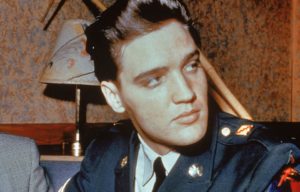
During the mid-20th century, a number of Hollywood’s biggest stars answered the call to serve in the U.S. Army—including Elvis Presley. Drafted in late 1957, Presley chose to forgo special treatment, insisting on serving as a regular soldier despite his global fame. Even so, his time in uniform inevitably differed in certain ways from that of his fellow servicemen who lived outside the spotlight.
Elvis Presley is drafted into the US Army
Elvis Presley’s induction into the U.S. Army just before Christmas 1957 stunned the music world. Already a global icon, his career was rapidly ascending, and many feared that military service could interrupt his extraordinary momentum.
Although he had the option to join Special Services—the Army’s entertainment branch, which would have kept him out of regular duty—his manager advised him to enlist as a standard soldier, taking on the same responsibilities as any other recruit.

Elvis Presley reported for duty at Fort Hood, Texas, on March 24, 1958, where he was assigned to the 2nd Armored Division, widely known as “Hell on Wheels.” His arrival drew intense media coverage, with crowds of fans gathering in hopes of seeing the global superstar.
After completing basic training, Presley traveled to Europe aboard the USS General George M. Randall (AP-115). He was then stationed in Friedberg, where he served with the 3rd Armored Division.
Elvis Presley’s military service
Publicly, Elvis Presley was happy with his stint in the military, particularly enjoying the portions of tank training. However, behind the scenes, he was not as content. He reportedly missed home and his family, and disliked training. As well, he was understandably worried about his career – or lack thereof – when his service was over.

Presley was genuinely determined to complete his service as a regular soldier, but, in reality, he had many unofficial benefits not afforded to other troops. Still, he was known to be extremely generous and provided those in his unit with television sets and extra fatigues. He also donated his wages to charity.
However, his service wasn’t all positive. While performing military exercises, Elvis was introduced to illicit substances, which he held in high regard for their energy and weight loss “benefits.”
Making America’s enemies uncomfortable
Elvis Presley’s presence in West Germany made America’s enemies uncomfortable, particularly the Soviet Union and East Germany. This created some serious tension between the US and the USSR, as the latter suspected the former was using Presley to lure defectors over the border.

East German Defense Minister Willi Stoph said Elvis and his music were a “means of seduction to make the youth ripe for atomic war.” Communist Party leader Walter Ulbricht added that it was “not enough to reject the capitalist decadence with words, to … speak out against the ecstatic ‘singing’ of someone like Presley. We have to offer something better.”
To counter rock and roll’s racy dancing, Communists created the Lipsi, a government-approved dance that was slightly more fun than standing on Legos. It was aimed toward young people and meant to win back rock and roll fans… Unsurprisingly, the dance not only never caught on, but was openly mocked.
Elvis Presley returns to the United States
Elvis Presley was discharged from the Army in March 1960 in what was a highly publicized event. Many were still bewildered by his decision to serve as a regular soldier, and he was asked why during the press conference. He responded:
“I was in a funny position. Actually, that’s the only way it could be. People were expecting me to mess up, to goof up in one way or another. They thought I couldn’t take it and so forth, and I was determined to go to any limits to prove otherwise, not only to the people who were wondering but to myself.”

On March 5, 1960, Presley was honorably discharged from active duty. Although he was terrified that his career had been killed by the military, his popularity had only risen while he was serving; his manager had secured plenty of material to drip-feed to the public while he was away.
More from us: Wilbert “Doug” Pearson Is the Only Pilot to Have Scored an Air-to-Space Kill
Presley’s popularity also took an unexpected turn during his service. Before he’d left, he was an extremely controversial figure – loved by teenagers and feared by parents. Becoming a symbol of rebellion, older generations believed Presley was a threat to the moral well-being of adolescents and was corrupting the nation.
However, when he returned, he’d gained considerable respect among older generations for his service. While many were still fiercely against Presley and his pelvic antics, his military career had actually given him a boost in fame.