When the M16 rifle was introduced during the Vietnam War, it was promoted as a major advancement for U.S. forces—lighter than previous service rifles, highly accurate, and well-suited to jungle combat. But battlefield experience quickly exposed serious shortcomings. Soldiers frequently reported malfunctions, including jamming and feeding failures, sometimes at the worst possible moments in the middle of combat.
Those repeated breakdowns damaged trust in the weapon and left many troops uncertain whether the M16 would perform when they needed it most. By comparison, the AK-47 earned a reputation for remarkable reliability. Its simple construction and ability to function in mud, rain, and harsh conditions made it highly dependable in the field. For many American soldiers, that contrast only sharpened frustration with the M16’s troubled early combat record.
Adoption of the M16 rifle in Vietnam
In 1966, Gen. William Westmoreland, Commander of the US Forces in Vietnam, introduced the M16 rifle as the new standard-issue infantry rifle, replacing its predecessor, the M14. Developed by engineer Eugene Stoner in the late 1950s, it was favored for its accuracy, light weight and the amount of fire it provided.
US Army soldier with the 1st Cavalry Division holding an M16 rifle during a patrol, January 1971. (Photo Credit: Christopher Jensen / Getty Images)
American troops in Vietnam were given a modified version of the M16, variant XM16E1. The weapon’s adoption was largely in response to the high number of casualties resulting from the enemy’s use of AK-47s. However, controversy surrounding the efficacy of the M16 prevented it from being issued to troops stationed in Europe and the US.
The M16 rifle jammed… A lot
Early versions of the M16 were plagued by significant reliability problems. A frequent issue, called a “failure to extract,” happened when a spent cartridge became lodged in the chamber, resulting in a jam. In some situations, this caused the rifle to function more like a single-shot musket than a fully automatic weapon, leaving soldiers vulnerable during combat.
United Press International reporter Betsy Halstead learns how to fire an M-16 automatic rifle while at the Khe Sahn special forces camp during the Vietnam War. (Photo Credits: Bettmann / Getty Images).
The most reliable way for soldiers to clear a jammed cartridge was to manually push it out, using a steel rod inserted through the barrel to dislodge the stuck casing.
The M16 was still seen as more effective than the M14
It was later found that the jamming problem was caused by switching to ball powder, which was meant to boost the muzzle velocity to 3,250 feet per second.
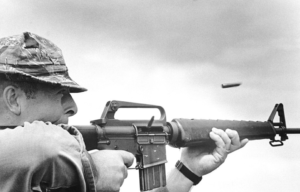
Spent shell casings from M16 rifles at the Fort Dix firing range, New Jersey, 1967. (Photo Credit: Leif Skoogfors / Getty Images)
Even with these problems, the M16 was still seen as better than the M14. In fact, the US Army even called it the best rifle for combat in Vietnam. To fix the issues, they improved training, adjusted the gunpowder formula, and made sure cleaning kits were widely available—but not before a Congressional report brought attention to the problems.
A harrowing report is released
A 1967 survey found that nearly 80 percent of the 1,585 soldiers had experienced M16 rifle malfunctions during combat. Frustrated by the weapon’s reliability issues, many described their experiences in letters home, which were later shared with members of Congress. As those accounts accumulated, the House Armed Services Committee began investigating the growing concerns.
Rifleman with the 1st Cavalry Division holding an M16 rifle, October 1967. (Photo Credit: Bettmann / Getty Images)
Congressional action led to the formation of a Subcommittee tasked with investigating the M16 rifle. Its comprehensive review confirmed the concerns raised by soldiers, finding that the Army had not adequately trained troops to use the weapon, failed to ensure the ammunition was compatible with the rifle, and did not provide enough cleaning kits to help prevent malfunctions.
Even after the investigation’s conclusions, the military continued to issue the M16. As the rifle’s reliability problems remained unresolved, many service members lost faith in it and began looking for alternative options while in combat.
Picking up the AK-47
During the Vietnam War, many American troops developed a grudging respect for the AK-47, the standard weapon carried by Viet Cong and North Vietnamese forces. In the 1950s, China began manufacturing its own variant, the Type 56. Slightly lighter and more compact than the original Soviet design, it retained the ability to fire in both semi-automatic and fully automatic modes.
The AK-47 became known above all for its durability and reliability in combat. It could withstand mud, moisture, and rough handling while continuing to operate with minimal maintenance. Its simple, rugged design also made it easy to learn and use effectively, even for fighters with limited training. In the extreme heat, dense terrain, and constant humidity of Southeast Asia’s jungles, that dependability made it an especially effective battlefield weapon.
US Marine who survived an ambush with a bullet-nicked ear and a captured Viet Cong AK-47, December 4, 1967. (Photo Credit: Ed Palm Photo / Getty Images)
Many American soldiers became increasingly frustrated with the M16 rifle, particularly because of its tendency to jam under combat conditions. By comparison, the AK-47 earned a strong reputation for reliability, leading some U.S. troops to prefer it in the field. Soldiers came into possession of AK-47s in different ways—some were taken from enemy fighters, while others changed hands through informal trades or discreet purchases.
Even as reports of malfunctions spread throughout the ranks, military leadership continued to argue that the M16’s problems stemmed primarily from improper handling or inadequate maintenance rather than defects in the rifle’s design. For many troops on the ground, however, that explanation did little to ease concerns, especially when reliability could mean the difference between life and death in combat.