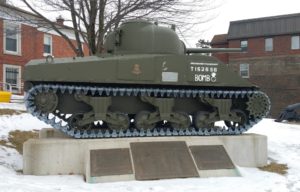
Many tanks of the Second World War struggled with mechanical reliability, particularly heavy German vehicles such as the Tiger and King Tiger. The M4 Sherman, however, developed a reputation for being far more dependable. One of the best examples was a Canadian M4A2 Sherman known as “Bomb,” which served from the Normandy landings on D-Day through the end of the war in Europe without experiencing a single mechanical failure. For an armored vehicle operating under wartime conditions, this was an extraordinary accomplishment.
Bomb was the 898th tank produced at General Motors’ Fisher Tank Arsenal in Michigan. As a diesel-powered M4A2 variant, it was later transported to the United Kingdom and assigned to the 27th Armoured Regiment, the Sherbrooke Fusiliers. There, it was prepared for participation in the Allied invasion of Normandy and the campaign that would follow across Western Europe.
The Sherman tank

Bomb
On June 6, 1944, Bomb arrived at Juno Beach, which was to be cleared by the Canadians. It landed a little while after the first waves but was thrust straight into the thick of battle. The beach was softened up by naval and aerial bombardments, but two battalions of the German 716th Infantry Division put up stiff resistance while part of the 21st Panzer Division waited behind the lines in reserve.

Once the bulk of the beach’s defenders had been neutralized, it was time for men to move inland, including Bomb. The tank and the rest of the Sherbrook Fusiliers claimed 41 enemy tanks as they worked their way inland in just the first two days of fighting. In July, Bomb’s commander and driver were injured and were replaced, but the vehicle was still made the troop command tank.
Bomb was involved in actions surrounding Caen, before moving on to help clear the city of Falaise. From here, it made its way into Belgium and then Holland, fighting the enemy every step of the way. As part of Operation Blockbuster, Bomb fought in the Hochwald forest in Germany, which was the setting for some of the biggest tank-on-tank engagements of the war.
After this, they reached the Rhine River, a natural barrier preventing them from continuing their advance. However, not even a river was going to slow Bomb down. The Fusiliers sealed up all the gaps in their tanks to make them waterproof and attached hoses filled with compressed air for buoyancy. They then floated their 30-ton tanks across the river, to the surprise of the German defenders.
Bomb carried on through Germany, facing desperate, fanatical resistance defending their homeland with nothing to lose. The tank was finally informed that the war was over through the radio on May 8, 1945.
After action

Since D-Day, Bomb had traveled 2,500 miles, fired 6,000 rounds of ammunition, received two hits, and seen many crew members come and go. Its dedicated crew ensured Bomb never missed a single day of action.
More from us: MoH Recipient Singlehandedly Destroyed A Tiger Tank And Captured 17 Germans
Once the war had ended, Bomb no longer had any use, and was parked up in a scrapyard in Belgium, awaiting the gas torch. Thankfully, the tank was saved from being scrapped, and was transported back to Canada to be put on display.
Today, it can be seen guarding the William Street Armoury in Sherbrooke, Quebec. It was restored with information plaques and an accurate wartime color scheme in 2011.