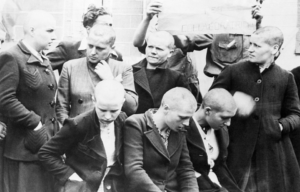
When France was liberated in 1944, foreign press agencies captured the aftermath through photographs. Among these were images of thousands of French women having their heads shaved. Without context, the photos seem puzzling, as many of the women appear pensive while a crowd of onlookers observes. Yet, these scenes depict a punishment for women accused of horizontal collaboration—having cooperated with the German occupiers.
Collaboration with the enemy took various forms, such as supplying them with resources, fighting alongside them, or even acting as a double agent under certain conditions. The women in these images, however, were a different type of collaborator, as they had formed relationships with German soldiers during France’s occupation.
German Occupation of France

France was invaded by German forces in May 1940 and defeated within a month, forcing an armistice between delegates from both countries. This marked France’s official surrender, and divided the nation into two zones: the German-occupied north and the French-controlled south, which was known as Vichy France.
Marshal Henri-Philippe Pétain was the authoritarian figurehead for Vichy France, where he acted in line with Germany, leading to tens of thousands of Jewish citizens being expelled from the region during this time. Some sources claim he’d hoped to act as a mediator between France and the Axis powers, to both keep German troops out of Vichy and to aid the French Resistance.
It wasn’t until November 1942 that German troops took Vichy, in retaliation for the involvement of Free French forces in North Africa. According to Germany, the acts committed by the French forces in the region had violated the armistice agreement that had been signed over two years prior.
Horizontal collaboration

During the German occupation of France, many women began relationships with enemy soldiers. Many of those who wound up with Germans were young mothers whose French husbands were in prisoner of war (POW) camps. The only way they could support themselves and their children was to enter into these relationships.
Many women, particularly in Paris, were forced into clubs to have relations with German soldiers for money. They were so popular that German and French officials worked together to regulate these establishments and build new ones, forcing even more women into this line of work. On occasion, some were even kidnapped from rural areas and brought to larger cities.
While many French and German relationships were forced, there were some that were based on a romantic connection. Many photos were taken from German POWs, which clearly showed them with their French girlfriends or wives during the the Second World War.
Whether the relationships were optional or forced, they were considered horizontal collaboration and something the women were heavily persecuted for at the end of the conflict.
Retribution for horizontal collaboration

France was liberated following the Allied landings in Normandy, which led to their advance into Caen and Paris. Although the Germans were ordered to destroy the capital, they ultimately surrendered.
Between this liberation and the end of the war, Allied forces focused on expelling the remaining German troops from France, while citizens took action against those accused of horizontal collaboration.
Some women who had romantic relationships with German soldiers managed to escape this retribution by traveling to Germany with their husbands or boyfriends during the liberation. Those who stayed behind, however, became targets due to their horizontal collaboration. In fact, the outrage against these women was so intense that some were wrongly accused of fraternizing with the enemy.
Les femmes tondues

Before the Liberation of France, thousands of women accused of so-called “horizontal collaboration” with German occupiers were punished by having their heads shaved in public so they could be easily recognized. Referred to as les femmes tondues, an estimated 20,0000 women faced these accusations.
For many, the humiliation did not end with a shaved head. Some were forced to appear partially unclothed before hostile crowds, mocked, covered in tar, pelted with stones, kicked, beaten, spat on, and in some cases, murdered.
The groups carrying out these punishments included both members of the French Resistance and, paradoxically, people who had themselves collaborated with the Germans. By joining in the persecution, some collaborators sought to deflect suspicion from their own actions during the occupation.
Recognition as German citizens

The relations between French women and German soldiers is said to have produced 200,000 offspring. Many of these children were raised not knowing who their fathers were, and those who did often kept it private for fear of being ridiculed. If it was known they were the child of a German soldier, they were subjected to abuse and shunning, even by members of their own family.
Many didn’t find out about their parentage until after their mothers had died and they came across letters and other mementos from the war. These discoveries prompted an increased number of war children who also wanted to reach out and either find their birth fathers or gain German citizenship.
Many of these children have been granted dual French and German citizenship. Germany put forward this offer to atone for its occupation of France during the Second World War and, surprisingly, France has also put it forth as recognition for its poor treatment of these individuals’ mothers.