Development of jet technology during World War II

When discussing advanced WWII aircraft, German models like the Heinkel He 162 Volksjäger, Messerschmitt Me 262, and Heinkel He 163 Komet often come to mind. However, the Allies weren’t far behind with the development of jet technology.
The British pioneered the first turbojet engine. It was designed by Royal Air Force (RAF) officer Frank Whittle in 1930, and the breakthrough led to the creation of the Gloster E.28/39, the first Allied jet aircraft, which made its first flight in 1941. Not long after, the United States introduced its own jet fighter, the Bell P-59 Airacomet, which entered service in October 1942.
While 66 units were produced, the P-59 never saw combat, as it lacked the performance needed for battle. It couldn’t match the speed of the latest piston-powered fighters, and the RAF deemed it inferior to the Gloster Meteor. As such, it was primarily used for pilot training.
Closing the gap

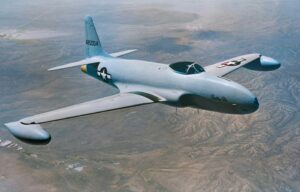
Realizing the need to catch up with the British and Germans, the United States developed the P-80 Shooting Star. Designed by Lockheed, it was the only Allied jet of the Second World War to have the engine mounted within the fuselage.
The development of the P-80 was driven by the Allies’ discovery of the Messerschmitt Me 262 in spring 1943. The US decided to use existing British jet research and fit the aircraft with the Halford H-1B Goblin engine, to give the P-80 performance that could match the Me 262.
Work began on the P-80 in May 1943 – without the engine, as it wasn’t yet available from the United Kingdom. Lockheed Chief Engineer Kelly Johnson gathered a team of engineers and told them their orders: they were to develop a new aircraft prototype for the USAAF. They would perform their job with the utmost secrecy, working six 10-hour days a week, as this new jet fighter needed to be completed within 150 days.
Skunk Works created the first prototype, the XP-80 Lulu-Belle, in early 1944, after 141 days of work. Powered by the British H-1B engine, Lulu-Belle first flew on January 8 of that year and, in further tests, exceeded 500 MPH at over 20,000 feet. This made it the first USAAF turbojet aircraft to surpass that speed in level flight.
After the first flight, Johnson remarked, “It was a magnificent demonstration; our plane was a success – such a complete success that it had overcome the temporary advantage the Germans had gained from years of preliminary development on jet planes.” This success prompted the development of additional prototypes.
Lockheed P-80 Shooting Star specs

The P-80 Shooting Star featured a carefully balanced fuselage that helped keep its center of gravity in the optimal position. A bubble canopy gave the pilot a broad, largely unobstructed view in all directions. As development progressed, the British powerplant installed in the prototype was replaced with an American-built Allison J33-A-35 turbojet mounted within the fuselage. Producing 4,600 pounds of dry thrust, this engine enabled the P-80 to reach approximately Mach 0.76 and travel about 825 miles without refueling.
Flying secret missions over Italy

The U.S. Army Air Forces saw the Lockheed P-80 Shooting Star as a potential counter to Germany’s jet-powered Messerschmitt Me 262 and acted quickly to evaluate the aircraft in an operational setting. Four YP-80A prototypes were sent to Europe. Two went to Britain for testing, pilot familiarization, and demonstration flights, while the other two were delivered to the 1st Fighter Group at Lesina Airfield in southern Italy.
The situation in Italy presented its own challenges. During the closing stages of the war, the Luftwaffe introduced advanced jet aircraft into the region, including the Arado Ar 234 Blitz. This high-speed reconnaissance aircraft could evade nearly all conventional Allied fighters while carrying out intelligence missions, making the arrival of the YP-80A a promising opportunity for Allied commanders seeking an interceptor capable of catching it.
One of the aircraft assigned to the 94th Fighter Squadron completed two flights over Italy. While these missions were officially classified as non-combat, they yielded important information on the performance of jet fighters under frontline conditions. Ultimately, production delays kept the P-80 from reaching widespread operational service before World War II ended, reducing its overall impact on the conflict despite its considerable potential.
Death of Richard Bong

Maj. Richard Bong was the top American flying ace of the Second World War, serving in the Pacific Theater. He claimed his first kill in December 1942 and scored an additional four the following summer, securing a promotion to the rank of captain. By the time the conflict came to an end, he’d racked up more kills than famed World War I ace Eddie Rickenbacker, with 40 credited to his name.
Following his service with the USAAF, Bong became a test pilot. On August 6, 1945, he took off in a P-80 Shooting Star, which immediately suffered a malfunction with its primary fuel pump. Bong never switched on his auxiliary fuel pump, and when he attempted to eject from the aircraft, he was too close to the ground and perished.
Lockheed P-80 Shooting Star’s post-war service

Following World War II, the P-80 Shooting Star—redesignated as the F-80—remained an active part of the U.S. arsenal, notably serving as a fighter-bomber during the Korean War. The U.S. Navy also received modified P-80A units for operations aboard the aircraft carrier USS Franklin D. Roosevelt (CV-42).
Over 1,700 P-80s were produced, and the platform saw continuous refinement. One of its most notable adaptations was the T-33 trainer, which went on to serve in the air forces of numerous countries, with 6,557 units produced before production ended in 1959.
Beyond combat, the P-80 helped push the boundaries of aviation. On June 19, 1947, Col. Albert Boyd flew a P-80R to a then-world speed record of 623.73 miles per hour. The aircraft also made history in aerial refueling, becoming the first jet to be successfully refueled mid-air under combat conditions.
Deployment of the Lockheed F-80 Shooting Star

The most well-known variant of the P-80 Shooting Star was the F-80. Intended to be a high-altitude interceptor, it took on several roles throughout the Korean War, including as a photo reconnaissance aircraft (RF-80), a day fighter, and a fighter-bomber. It notably flew combat sorties against North Korean-flown Mikoyan-Gurevich MiG-15s, as well as against Ilyushin Il-10 ground attack aircraft and Yakovlev Yak-9 fighters.
Most notably, the F-80C secured the first American jet-versus-jet kill during a dogfight against enemy MiG-15s on November 8, 1950, with pilot Lt. Russell Brown in the cockpit. An estimated 75 percent of enemy losses during the first months of the conflict were attributed to the aircraft. That being said, 368 were lost, the majority to ground fire.
Given its WWII-era origins, the F-80 was slower than anticipated. This eventually led to the North American F-86 Sabre taking over the aircraft’s combat role in Korea.
Lockheed P-80 Shooting Star’s legacy

As one of the first American jet fighters, the P-80 Shooting Star was instrumental in ushering U.S. aviation into the jet era and in shaping the design of later fighter aircraft. Although it saw only limited combat during World War II, it confirmed the practicality of jet propulsion and influenced the development of subsequent landmark jets, including the F-86 Sabre and the MiG-15.
More from us: Messerschmitt Me 410 Hornisse: The German Bomber Destroyer That Was No Match for Allied Fighters