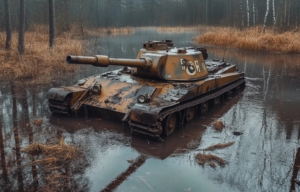

Before one can understand the magnitude of such a discovery, one must first be given a proper history of the T-34. Introduced into service with the Red Army in 1940, this medium tank became the most-produced of the Second World War, as well as the second most-produced of all time, after the T-54/T-55. A total of 84,070 were built: 35,120 of the original model and 48,950 of the T-34-85 variant.
The T-34 initially featured the 76 mm tank gun M1940 F-34 as its main armament, with two 7.62 mm Degtyaryov (DP) machine guns providing additional firepower. While not as heavily armored as other tanks during the war, it had a unique sloped design, which effectively protected the vehicle and its crew of four from anti-tank weaponry. Pair all this with wide tracks and a V12 diesel engine, and the Soviets had a leg up on their German opponents.
Germany didn’t know about the T-34 until Operation Barbarossa

Prior the the German invasion of the Soviet Union, better known as Operation Barbarossa, the Wehrmacht wasn’t aware of the T-34’s existence, nor that of the powerful Kliment Voroshilov (KV) heavy tank. They, therefore, believed they would encounter little resistance as they made their way across the Eastern Front. The Germans were surprised by the strength of the Red Army’s tank divisions and subsequently increased the development of their own tank technologies.
The T-34, however, wasn’t without its faults, and by the final years of the war found itself being outmatched by newer tanks. That being said, it continued to see service with the Soviet Union and its allies, including during the Korean War and the Angolan Civil War. The North Vietnamese Army (NVA) even equipped troops with the T-34-85 during Operation Lam Son 719 and the 1975 Spring Offensive, among other Vietnam-era engagements.
Battle of Narva

Having established the significance of the T-34 tank, let’s set the stage for the capture of this particular vehicle. From February to August 1944, intense battles unfolded between the Germans and the Red Army along the 50 km-wide Narva Front in northeastern Estonia. This offensive proved particularly deadly, with casualties exceeding 100,000 killed and over 400,000 wounded.
During this time, the German Army’s Detachment “Narwa,” reinforced by volunteers and Estonian conscripts, clashed with the Soviet Leningrad Front over control of the strategically crucial Narva Isthmus. This offensive saw two major engagements: the Battle for Narva Bridgehead and the Battle of Tannenberg Line.
As an extension of the Leningrad-Novgorod Offensive, the Red Army established bridgeheads on the western bank of the Narva, while German forces held several on the eastern side. The Germans consistently repelled Soviet attempts to advance. In the end, the Soviet objective of reclaiming Estonia as a staging ground for seaborne and airborne attacks against Finland remained unachieved.
Capture and abandonment of a Soviet T-34


More than 50 years after the war, the boy, by then an adult, shared his memory of the 1944 incident with Igor Shedunov, who headed a local military history club. The story raised the possibility that a tank might still be concealed beneath Lake Mätasjärv, prompting Shedunov and the club’s members to investigate.
The group had the necessary resources for the search, including separate teams devoted to land-based work and underwater exploration. Mihail Zenov led the divers assigned to examine the lake’s dark, murky waters.
Their initial efforts produced no results. Nothing on the surface, such as patches of oil or rising bubbles, indicated that a tank was submerged below. The team continued searching, however, and eventually discovered the missing vehicle roughly seven feet underwater, covered by almost ten feet of dense peat and silt.
A coordinated effort to retrieve and repair

After the T-34 was discovered, efforts began to recover it from the depths of Lake Mätasjärv. On September 12, 2000, a Komatsu D375A-2 was used to pull the tank from its submerged location. Once it surfaced, the war history club identified the tank as a T-34/76A and discovered an unexpected cache of 116 shells inside. Despite being underwater for about 56 years, the tank remained in surprisingly good condition, with no visible rust. All of its systems, except the engine, were still functional.
Following the tank’s recovery, news of the find spread quickly, drawing the attention of then-Estonian President Lennart Meri, who came to inspect it.
Under Estonian law, the club was not allowed to claim ownership of the tank for five years. After this waiting period ended, the club members initiated a detailed restoration process, aiming to restore the T-34 to its original condition, including a complete overhaul of its components.
Where is the Soviet T-34 today?

The current whereabouts of the T-34 are unknown. Some sources claim it was last seen on display at the Estonian War Museum in the village of Gorodenko, while others have said it was awaiting reassembly at the war history club’s workshop near Sirgala, in the northeast.
More from us: Relic Hunters Surprised By What They Discovered In WWII-Era Bomber
Wherever it may be, military and history enthusiasts alike hope the T-34 is being well cared for. This tank is an important piece of history and one of the few surviving examples of the fighting that occurred on the Narva Front during World War II. It would be a shame for it to be lost (again).