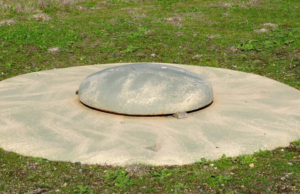
The Fort Hommet headland in Guernsey, part of the Channel Islands, is home to many good examples of German defensive and offensive bunkers, along with other associated military structures. A unique M19 Maschinengranatwerfer (mortar bunker) has, over the recent years, been brought to a point where it can be opened to the public for private and public tours or on special open days.
Next to it is a restored gun casemate bunker, making this small area adjacent to Vazon Bay an excellent place to learn about how the Germans went about defending Guernsey.

After bombing the main harbors of both Jersey and Guernsey, they Germans captured the Channel Islands in June 1940. The bay itself could be suitable for a beach landing by the Allied forces, so the Germans made sure the gently-sloping coastal area could be well defended.
Arcs of gunfire made sure coverage would deter any insurgents arriving by sea. Plus, this headland had the aforementioned M19 automatic mortar that could fire up to 120 five-cm mortars a minute onto the beach and surrounding headland.

It was almost a year before orders came down from the Führer that the islands were to be fully defended and some 200/250+ strongpoints built, including those on Guernsey. Built by Organisation Todt, this fortification program on the Channel Islands was followed personally by the Führer, who received bi-weekly reports of its progress.
Guernsey, being the more remotest in the group, received special treatment, as it had the largest artillery pieces placed there. These were at Batterie Mirus (originally called Batterie Nina), with four guns in a complex at the island’s center that could fire some 26 miles out to sea.

However, this beach area required a smaller, yet more numerous variety of weapons to defend it, such as the 10.5-cm reinforced casemate now owned by Richard Heaume MBE, who operates the well-known German Occupation Museum on Guernsey. Over the years, he’s brought the casemate back to how it would’ve looked during the occupation period itself, thanks to volunteers and helpers.
The M19 mortar bunker located almost next door has been a project for Festung Guernsey. Their aim is to make available to the public, visiting historic societies and academics examples of the most important fortifications built on Guernsey by the German occupying forces.

War history tourism on Guernsey is certainly one draw for some visitors. However, it’s also of interest to general tourists when they learn about or see so many constructions across the island – then they’re, too, attracted to this part Guernsey’s history and story.
Between the two organizations, the headland at Fort Hommet has become a place for locals and tourists to see and touch what was an amazing construction undertaking for the Germans, in order for them to try to hold onto Guernsey. Sadly, the work was carried out under massive duress, mainly by enslaved or forced workers from places like the conquered Slavic countries.

Knowledgable and experienced tour guides, like Amanda John with Tours of Guernsey, are certainly a good place to start.
More from us: Rare American Civil War-Era Medal of Honor to Go on Sale in Britain
The Guernsey Tourism Office would also be worth contacting at +44 1481 223552. Its Visitor Information Centre is located in Unit 5A, in the Market Buildings on the island.