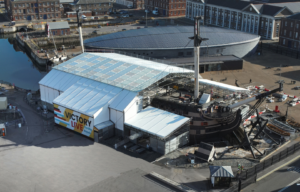
War History Online guest writer Geoff Moore has been investigating Lord Horatio Nelson’s flagship, HMS Victory. The 104-gun vessel is currently under a 10-year repair program at HMNB Portsmouth, in the United Kingdom. Moore had the opportunity to question one of the senior conservators, Deputy Project Director Patti Pierazzo, about how work is progressing and what they’ve discovered about the ship’s history so far in the rebuild and repair.

Geoff Moore: How is work progressing on the Big Repair?
Patti Pierazzo: The Big Repair is a 10-year conservation scheme and is on schedule for completion in 2033. However, given the scale of the project and the variables at play, the schedule has to be reactive and flexible to meet the requirements of each phase.
Overall, this ambitious program of conservation work will bring [HMS Victory] back to the best possible condition, to enable her survival for a minimum of 50 years, without major intervention beyond any planned maintenance. Upon completion, the fully re-rigged ship will be unveiled once again as the symbol of the Royal Navy and a poignant testimony to the Age of Sail.

GM: How many are taking part in the work?
PP: HMS Victory: The Big Repair benefits from a diverse multi-disciplinary team of 30, comprising a variety of professionals who are working collaboratively to meet the requirements of such a complex conservation effort. This includes:
- A highly skilled team of boatbuilders
- An expert team of archaeologists and heritage advisors
- Specialist conservators and scientists
- Engagement and management teams
Under the boatbuilders section (as of mid-January 2026), there are 14 shipwrights, one carver, one laminator and four lead shipwrights.

GM: Have any unexpected items been found during this conservation project?
PP: For today’s teams, it’s common to find small artifacts lost within the ship’s hull, likely left by earlier workers. These finds range from a 30-year-old chocolate wrapper to screws from the 1800s.
Each discovery gives a glimpse into the everyday lives of people who worked on the vessel’s various conservation phases.

GM: Have you found any markings or graffiti from artisans who worked on or built HMS Victory?
PP: As we’ve peeled back HMS Victory’s layers and the stories across five major repairs since 1765, discovering the ordinary people who helped her survive has been fascinating. We often find markings from past shipwrights, [who left] their initials or dates partially hidden during the repairs, with the oldest marking believed to be dated between 1801-24.
Recently, our shipwrights were given a similar opportunity while working on the ship to leave their marks, too. When we installed the 100th futtock (a large curved timber that form the “ribs” of the ship), [they] left their legacy on Victory, engraving their names onto one futtock before it was lowered into the starboard side of the hull.

GM: How faithful are you to the construction techniques historically used on HMS Victory over time?
PP: Today, we combine modern techniques with traditional skills. For example, the tools and techniques [used by] the riggers working on the vessel are virtually the same as they’d have been in the 18th and 19th centuries. It’s great that while we preserve HMS Victory for future generations [that] we’re also able to preserve endangered skills that are more than 200 years old.
GM: What is the project team most excited about, in regards to working on HMS Victory and the Big Repair?
PP: HMS Victory is Britain’s most celebrated warship, and our team often expresses their excitement about working on such a significant vessel while discovering more about her history.
Learning about the items found on board makes us feel closer to the previous stories of her conservation work. It’s proof that Victory’s significance has gone beyond Adm. Nelson and the Battle of Trafalgar, and that her story is constantly evolving.

GM: Where are you sourcing the timber?
PP: An answer that’s possibly the most controversial in connection with HMS Victory and her history. (Note: This is my own personal feeling!)
When it came to sourcing the wood to repair and replace Victory’s hull, we knew this decision would have an impact on forestry resources. For this reason, we decided to only purchase oak sourced from France, a country that prides itself on the sustainability of its forestry sector. To certify our efforts, we’re now in the process of obtaining the Programme for the Endorsement of Forest Certification (PEFC) for the project.
Victory is an irreplaceable national asset, and we’re committed to ensuring the ship’s survival by using timber of the best available quality. In order to extend the time between major repairs to 50 years, and to ensure we protect the historic timber in Victory, we require timber of a much higher grade than was originally used in her construction.
More from us: ORP Błyskawica: Poland’s World War II-Era Naval Beast
Some say Nelson might have been shocked, but the Royal Navy has a long history of using timbers from across Europe – and the world – in building ships, so we like to think that, actually, he would have approved of the best, most sustainable oak being used.