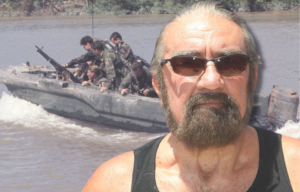

Richard Marcinko’s service during the Vietnam War

During his second tour, Marcinko led his platoon through the Tet Offensive, assisting US Army Special Forces in rescuing trapped American nurses and a schoolteacher. His leadership was so effective that the North Vietnamese Army (NVA) placed a 50,000 piastre bounty on his head, promising payment to anyone who could kill him and provide proof.
Marcinko received numerous awards for his service across both tours: the Silver Star, four Bronze Stars with combat V, two Navy Commendation Medals, the Legion of Merit, and the Vietnamese Cross of Gallantry with Silver Star. However, despite his impressive service in Vietnam, this period was not what he would become best known for in his military career.
US Navy SEAL Team Six

In 1973, following a short assignment as the U.S. Navy’s attaché in Cambodia, Richard Marcinko took command of SEAL Team Two, leading the unit from 1974 to 1976. His leadership style—bold, unconventional, and often controversial—strengthened his reputation and helped reshape the culture of naval special warfare.
After the 1979 Iran Hostage Crisis exposed the lack of a dedicated U.S. counterterrorism force, Marcinko was tasked with creating a highly specialized team capable of executing rapid, high-risk missions worldwide. The result was SEAL Team Six, which he established and commanded from 1980 to 1983.
Marcinko handpicked many of the unit’s members, selecting operators he trusted from prior assignments. Though critics questioned this method, it produced a tight-knit group of seasoned and combat-proven personnel. Even the designation “Team Six” reflected strategic misdirection: at the time, only two SEAL teams officially existed, and the inflated numbering was intended to mislead Soviet intelligence about U.S. capabilities during the Cold War. Cloaked in secrecy, the unit’s early development and missions set the stage for the evolution of modern Navy special operations forces.
Running Red Cell

After stepping down as commander of SEAL Team Six, Richard Marcinko was given a new mission: to create a specialized unit that would test the Navy’s vulnerability to terrorist attacks. This new team, called Red Cell, had a unique and unconventional role—its members were not only permitted but actively encouraged to simulate terrorist tactics to expose security weaknesses at U.S. naval bases.
Red Cell operated like a real threat, using fake IDs, infiltrating secure areas, taking hostages, and setting up barricades to highlight flaws in base security. The team even went as far as kidnapping high-ranking officials, documenting the entire process to later show base personnel just how vulnerable they were. As described by Marcinko, “I’d tell them Red Cell was coming, eat them alive, and then show the film and rub their noses in it.”
A prison sentence and civilian life

Part of the controversy surrounding Richard Marcinko’s legacy comes from his alleged involvement in a “kick-back” scheme involving the price of hand grenades. According to prosecutors at his trial, he conspired with an arms dealer in Arizona to overcharge the government by nearly $113,000 on a contract to produce grenades.
Marcinko was convicted of conspiracy to defraud the government and was fined $10,000. He was sentenced to federal prison for 21 months, serving only 15 months of his term. He maintained his innocence until his death, claiming he was the subject of a “witch-hunt” because of his work with Red Cell.
After retiring from the Navy and serving his time in prison, Marcinko went on to have a successful civilian career, which was largely focused on the work he did while in the military. He wrote an autobiography, titled Rogue Warrior, as well as fictional books. He also hosted a radio show, America on Watch with Dick Marcinko.
On December 25, 2021, Marcinko died from a heart attack at his home in Fauquier County, Virginia. He was 81 years old.
The controversial legacy of Richard Marcinko

As a figure, Richard Marcinko remains highly controversial. He’s often commended for his military actions, particularly with his involvement with SEAL Team Six, which went on to be heavily involved in the war on terror. There’s no doubt his actions played an important role in the group’s counter-terrorism efforts throughout the Cold War and into the present.
However, there are others who feel many of his methods were appalling. He was known for his general disregard of the rules, and had a leadership style that brought him into conflict with superiors. His second-in-command of SEAL Team Six went so far as to say that Marcinko left “a mess” in his wake.
He was, however, remembered more positively by Adm. William McRaven, who said of him:
“While we had some disagreements when I was a younger officer, I always respected his boldness, his ingenuity and his unrelenting drive for success. I hope he will be remembered for his numerous contributions to the SEAL community.”