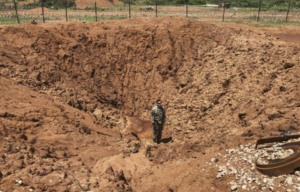
In September 2019, Somalia’s Baledogle Military Airfield became the scene of a violent confrontation when al-Shabaab—the al-Qaeda–linked extremist group designated a terrorist organization by the U.S. State Department—launched a large-scale assault on the installation. At the time, soldiers from the New Jersey Army National Guard’s 102nd Cavalry Regiment were stationed at the base, working alongside Somali forces in an advisory and support role.
The attack was swift and well-coordinated. Al-Shabaab militants initiated a complex strike that quickly escalated into an intense firefight, placing American and Somali defenders in immediate danger. Drawing on rigorous training and effective coordination, the joint force held its ground and repelled the assault. The attackers sustained heavy casualties, while all U.S. personnel emerged unharmed.
This engagement marked the most significant direct clash between U.S. troops and al-Shabaab since the 1993 Battle of Mogadishu. It served as a stark reminder of the group’s continued ability to mount sophisticated attacks and reinforced the ongoing necessity of U.S. counterterrorism operations aimed at maintaining security and stability across East Africa.
History of Baledogle Military Airfield

Located roughly 60 miles northwest of Mogadishu in Somalia’s Lower Shabelle region, Baledogle Military Airfield has long held strategic importance. Constructed in the 1970s with assistance from the Soviet Union, the base was designed to support Somali Air Force operations and host foreign military advisors, quickly becoming a vital installation in the region. Its significance grew during the UNOSOM II mission between 1993 and 1995, when the U.S. Army’s 10th Mountain Division relied on Baledogle as a central operational base.
Beginning in 2007, the airfield became home to a sustained U.S. military presence centered on counterterrorism efforts tied to the Global War on Terrorism. Today, Baledogle ranks among the most isolated American positions in East Africa and remains under constant threat from insurgent activity. A U.S. Special Operations Task Force is permanently based there, working in coordination with security contractors from Bancroft Global to protect the installation and support ongoing missions.
The 102nd Cavalry Regiment was prepared for a potential attack

In 2019, Charlie Troop of the 1st Squadron, 102nd Cavalry Regiment deployed to Somalia as part of Task Force Warrior, tasked with advancing U.S. military objectives and fostering cooperation with local Somali forces and civilians. The unit, which initially consisted of about 70 soldiers, expanded before deployment to include reinforcements such as fire direction officers from the 3rd Battalion, 112th Field Artillery Regiment, and a mortar platoon from the 2nd Battalion, 113th Infantry Regiment—bringing their total strength to roughly 160 troops upon arrival.
Once established at Baledogle Military Airfield, the soldiers knew an attack by al-Shabaab was not merely possible, but imminent. The militant group frequently conducted reconnaissance around the installation, observing defensive patterns and testing the troops’ responses. To preserve operational secrecy and avoid escalation, the 102nd Cavalry was under strict orders not to engage during these surveillance attempts.
In preparation for the inevitable, the troops maintained peak readiness through relentless training—executing live-fire drills, simulating attack responses, and patrolling the base perimeter. Guard shifts rotated continuously, ensuring that Baledogle remained alert and fortified at all hours.
al-Shabaab militants launch their attack

On September 30, 2019, members of the 102nd Cavalry were preparing a convoy to meet the chief of police and other leaders in a town 25 miles from Baledogle. At approximately 9:45 AM, they heard an explosion, which turned out to be the detonation of a vehicle-borne improvised explosive device (VBIED). The truck had been driving toward the airfield, but went off prematurely.
As the attack began, a UN aircraft was preparing to land and one manned by the US Air Force was about to take off. As well, 50 civilian construction workers were repairing the runway. The first course of action was to clear the area, so three soldiers were tasked with moving the civilians to safety, while the UN aircraft was diverted and the Air Force one told to immediately leave the area.
“I ran to the operations center and [Capt. London] Nagai was already maneuvering Charlie Troop toward the explosion site,” recalled Lt. Col. Richard Karcher, commander, Task Force Warrior. “He had the vehicles that were originally part of the convoy going to the airfield; he started moving additional personnel to the towers, which covered the approach to the airfield, and he closed all entry control points. Snipers were also posted base-wide.”
Members of the 102nd Cavalry ran to their positions both on the exterior of Baledogle and in the operations center, where they used cameras tethered to an aerostat to watch the base. As Nagai later explained, “The key was not engaging with the enemy until they were committed to utilizing a specific route that would ultimately be a fatal choice for them.”
They waited until the militants were right where they wanted them before launching their counteroffensive.
The then-largest VBIED used on the African continent

Ten minutes later, a second truck separated from a convoy carrying construction materials and drove toward the perimeter fence. The 102nd Cavalry fired at the vehicle, but their bullets couldn’t penetrate its reinforced, armored windows.
Luckily, before the attack, an engineer platoon had dug a trench around Baledogle’s outer boundary. It was designed to stop anything smaller than a tank—including the approaching truck. The vehicle got stuck in the trench, and the driver couldn’t reverse, giving the 102nd the chance to take it out.
Five minutes later, the truck exploded with the power of 4,000 to 5,000 pounds of explosives, making it the largest VBIED ever used in Africa at the time. The blast shook the base, ripped open a 200-yard-wide hole in the fence, and left a crater 20 feet deep.
A third truck hides 12 armed militants

Around 10 minutes after the second truck exploded, a third truck arrived at the hole in the fence line, stopping just short of the large crater. The wind then blew off the tarp covering the truck bed, exposing a group of a dozen al-Shabaab militants, armed with PKM machine guns, hand grenades, assault rifles, RPG-7s and ammunition.
It seemed that the militants tried to get inside the perimeter, not directly outside it, and they struggled to regroup in the midst of the confusion. Almost immediately, snipers Staff Sgt. Nicholas Swanson and Sgt. James O’Brien opened fire, killing half of them in just five minutes.
As the remaining militants sought shelter behind their truck, Capt. Nagai and Lt. Col. Karcher made the decision to deploy their mortar team. A combination of 60 mm, 81 mm, and 121 mm weapons was fired, along with both indirect and direct fire against them.
It was over in less than an hour

A ceasefire was later called, during which Lt. Col. Karcher’s team examined the third vehicle through the cameras set up around Baledogle. After consulting with a US Marine Corps unit assigned to the airfield, it was determined the truck was another VBIED, prompting the deployment of an Air Force drone to destroy it.
After less than an hour, the al-Shabaab militants had been completely wiped out. While the most recent press release states that none of the 102nd Cavalry’s members suffered injuries, a 2019 statement from US Africa Command (AFRICOM) did say a soldier suffered a concussion.
The engagement was the first time since the Second World War that a unit from New Jersey was involved in a combined arms battle, and it was the largest meeting between US forces and al-Shabaab since 1993’s Operation Gothic Serpent, which included the infamous Battle of Mogadishu. The latter was immortalized by 2001’s Black Hawk Down.
The day following the attack, al-Shabaab leadership published a letter and video online, claiming a decisive victory at Baledogle. This contradicted the real outcome, which saw the 102nd Cavalry secure a much-deserved win. However, as Karcher later said, “There is no question that if it hadn’t been for Charlie Troop, al-Shabaab would have destroyed the aircraft and killed as many people as possible.”
Militants opted to not launch any other attacks on Baledogle Military Airfield following the September assault. Seventy-six days later, on December 12, 2019, the 160 members of the 102nd Cavalry returned to the US.
The 102nd Cavalry Regiment are recognized for their actions

In the days following the engagement, members of the 102nd Cavalry were awarded the Combat Medical Badge, Combat Action Badge and Combat Infantry Badge, depending on their branch. Just under a year later, in August 2020, they received even more recognition at a ceremony at their home station in Westfield, New Jersey. During the ceremony, members were the recipients of Bronze Stars and Army Commendation Medals with Combat Device for their actions and bravery.
More from us: Operation Trent: The British Special Air Service’s Astonishing Daylight Mission in Afghanistan
Speaking about the bravery of those who fought the militants that day in September 2019, Capt. Nagai said, “The discipline and bravery of the Soldiers was something I will never be able to fully explain and something I am sure I will never see again.”