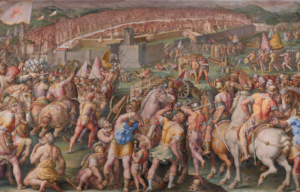
Throughout history, warfare has evolved through a constant struggle between the creation of formidable defenses and the ingenuity required to overcome them. In the modern era, static fortifications have largely lost their dominance, overwhelmed by advanced weapons systems. Small arms can punch through protective gear, guided missiles can obliterate armored vehicles, and precision strikes can shatter reinforced positions with alarming efficiency.
For much of the past, however, defenders often held the upper hand. When combat relied on hand-held weapons and rudimentary siege tools, massive stone walls and fortified strongholds were extraordinarily difficult to breach. This defensive advantage forced attackers to think creatively, giving rise to some truly unconventional solutions. The following examples highlight some of the most inventive and unexpected methods ever used to break through enemy defenses.
1. Rocket cats

In the 16th century, an artilleryman named Franz Helm, who resided in what is now Germany, wrote a book on munitions, weaponry, and artillery tactics. Within this book, he described a method for wreaking havoc on a defensive system or town using a cat. Helm explained:
Create a small sack like a fire-arrow. If you would like to get at a town or castle, seek to obtain a cat from that place. And bind the sack to the back of the cat, ignite it, let it glow well and thereafter let the cat go, so it runs to the nearest castle or town, and out of fear it thinks to hide itself where it ends up in barn hay or straw it will be ignited.
It remains unclear whether this rather ambitious plan was ever implemented, but if it was, it would have likely caused more harm to one’s own property than to the enemy’s.
2. Up the toilet

Rather than relying on conventional siege tools such as scaling ladders or rams, this bold maneuver turned the castle’s own design into a vulnerability. Château Gaillard, constructed in 1198 by Richard the Lionheart, was widely regarded as one of the most formidable fortresses in France. Even so, fewer than ten years later, King Philip II demonstrated that no stronghold was truly invincible. Although his forces had breached the outer works, the central keep continued to resist capture.
The breakthrough came through sharp observation rather than brute force. A soldier spotted a slim drainage shaft built into the wall, designed to carry waste from a latrine. Seizing the opportunity, he squeezed through the foul passageway, emerged within the keep, and opened a window from the inside. French troops quickly followed, flooding into the fortress and securing its fall.
3. Flinging corpses

During a siege, armies often established a nearby camp to serve as their base of operations. These camps were typically filled with unwell, unclean soldiers, creating conditions where disease spread rapidly.
In 1346, the Mongols besieged the Crimean city of Caffa, leading to a prolonged standoff. Over time, the Mongol forces themselves fell victim to the Black Death, which ravaged their camp. Instead of withdrawing, as many armies might in such a situation, the Mongols seized the moment, using catapults to hurl disease-ridden corpses over the city walls in an effort to spread the disease among the defenders.
While it is uncertain, some fleeing residents of Caffa may have carried the Black Death into Europe.
4. Hot Sand

In 332 BC, during Alexander the Great’s siege of the city of Tyre, the defenders inside heated fine sand until it glowed red, then poured it onto the attackers below. This approach was highly effective because the tiny sand particles slipped through the gaps in soldiers’ armor. The only escape was to remove the armor, which exposed them to archers.
Other similar tactics included the use of burning hay, hot water, and boiling oil.
5. Bees and beer
When attacking a walled area, the Vikings, who knew the defenders would be firing down onto them, used wooden structures called hurdles for protection while they made their way through the walls.
When they attacked the English town of Chester, the defenders gathered up as much beer as possible and heated it up, then poured it down onto the attackers, literally burning off their skin. Their wooden covers could resist projectiles, but the hot beer was able to seep through the gaps.
More from us: The Mulberry Harbor Paved The Way For Victory On D-Day
In response, the Vikings sealed their shielding with animal hides, deflecting the hot beer. Again in response, the defenders began throwing beehives at the Vikings, who were then savagely swarmed by angry bees.