Many everyday items are created to simplify daily life and improve efficiency. But have you ever stopped to consider their origins? It may come as a surprise that a number of these familiar products began as military innovations, originally developed to support service members at home and abroad.
Aviator sunglasses replaced goggles
The first aviator sunglasses were created by optics manufacturer Bausch & Lomb in the early 1930s. They were intended to replace the goggles test pilots wore to protect their eyes while flying. What came from this was a lighter and thinner product that provided better benefits than its predecessor. An unexpected result? The sunglasses were fashionable.

Bausch & Lomb soon rebranded the sunglasses as Ray-Bans and sold them in the wider commercial market. Their popularity grew as Hollywood stars started to don the eyewear, and the brand is still among the most popular today.
Duck tape or duct tape?
Did you know duct tape is a military invention dating back to 1942? What’s more, it was developed as a way for US soldiers to effectively seal their ammunition boxes against water damage.
The government approached Johnson & Johnson to develop a new waterproof adhesive and the result was called “duck tape.” Once dispersed among the US military’s population, it was adapted to fit a number of uses, including the repair of equipment.

Duck tape was eventually changed to “duct tape” upon entering the commercial market, as it was often used in ductwork repair. Its color was also changed to match that of HVAC systems.
Computer technology drastically advanced
Before the advent of modern technology, “computers” referred to those able to perform calculations by hand. It wasn’t until the US military developed a programmable system in the 1940s that an early version of the computer we know today was invented.

Called the ENIAC, it was a mammoth-sized machine used by the military to conduct ballistic calculations in the Ballistic Research Laboratory. Some of those to advance the system include Rear Adm. Grace Hopper, who developed the first computer programming language; Jean Bartik, whose work led to the development of stored-program computers; and Frances “Betty” Holberton, creator of the first software application.
The early days of the internet were a military invention
Before it became the World Wide Web, the early iteration of the internet was called the Advanced Research Projects Agency Network, or ARPANET. During the Cold War, the military used it to create a remote information-sharing system, driven by the fear that a central command location might be targeted by Soviet forces.

By the late 1960s, colleges gained limited access to ARPANET, allowing users to transfer files, remotely log on, and print documents. It went through numerous changes before becoming accessible to the general public with the invention of web browsers in 1993, marking the birth of the World Wide Web.
The Jeep, a military invention, is the world’s oldest SUV
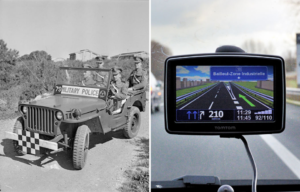
The Jeep was invented in 1940 after the US Army expressed a need for a light reconnaissance vehicle. In response, American Bantam presented a four-wheel-drive vehicle with the ability to reach speeds of 65 MPH. According to then-Gen. Dwight D. Eisenhower, the US couldn’t have won World War II without it, and it has since gone on to sell hundreds of thousands of units in the public market.

As for its iconic name? The initial “General Purpose” moniker was shortened to “GP” and later nicknamed “Jeep.” The rest is history!
Where would society be without GPS?
While it’s inconceivable to travel without the aid of GPS, that’s exactly what the general population had to do up until the 1990s.

GPS was created by the Department of Defense in the 1960s as a way to ensure military artillery reached its targets. After the Soviet Union shot down a Korean airliner that had flown off course, President Ronald Reagan saw a need for better navigational technology and implemented its first civil uses. This was done through selective availability to ensure hostile areas could not receive signals, and it allowed for improved mapping of regions.
President Bill Clinton discontinued the use of selective availability in 2000 to better serve civil GPS use.
Cargo pants were invented for convenience
While considered a fashion faux pas today, cargo pants were first worn by British soldiers in the late 1930s. They wanted a more convenient way to transport equipment, such as ammunition, and thus started sporting the multi-pocketed pants.

The original design included a pocket on the front of the hip and another on the side of the thigh. Seeing their effectiveness, the US Army adopted the look in the 1940s, and they eventually became a staple of civilian fashion throughout the 1990s.
Feminine hygiene products entered the commercial market
For centuries, women sought homemade solutions to deal with menstruation. It wasn’t until World War I that a product was made commercially available. Under government contract to create a cheap form of bandage, Kimberly-Clark Co. manufactured an absorbent material, called cellucotton, out of wood pulp.

The product caught the attention of Red Cross nurses, who used it during their monthly menstruation. After the war, the company repurposed the material into sanitary napkins and Kotex pads, which were sold across the country in department stores and pharmacies.
Forever thankful for aerosol bug spray
Those who regularly go camping know the importance of bug spray. It dates back to WWII, when soldiers stationed in the South Pacific expressed a need for a quick way to kill malaria-carrying mosquitos. While working with the Department of Agriculture, William Sullivan and Lyle Goodhue developed a way to emit insecticide as a mist.

The first was patented in 1941 and nicknamed the “bug bomb” by soldiers. A cheaper plastic version was released in 1949 by veteran Robert Abplanalp for commercial sale. It’s since been refined to ensure it’s less detrimental to the environment.
The EpiPen has been saving lives since the 1970s
In the 1970s, Sheldon Kaplan invented the device that would eventually lead to the EpiPen. Partnering with Survival Technology, he developed the ComboPen auto-injector, a tool intended to administer medication quickly and safely to soldiers exposed to nerve agents. Once activated, the antidote would rapidly enter the bloodstream to counteract the effects.

More from us: 5 Misleading Military Movies With Major Malfunctions
Kaplan later modified the device so it could administer epinephrine, a critical medication used to treat severe allergic reactions and anaphylactic shock. Although he received limited recognition during his lifetime, he was honored posthumously with induction into the National Inventors Hall of Fame in 2016.
In our view, among all the military-born innovations on this list, the creation of the EpiPen stands out as the most impactful and life-saving.