The Victoria Cross is the United Kingdom’s highest award for military gallantry, presented to those who display extraordinary courage in combat. Tragically, it is often bestowed after death, as such heroism can demand the ultimate sacrifice. Corporal Bryan Budd exemplified that reality when he lost his life carrying out a daring solo charge under sustained Taliban fire.
Just five days away from returning home, Budd chose to place his fellow soldiers’ safety above his own. His bold leadership and swift, decisive actions spared others, even as they sealed his fate. In his final stand, he reflected the bravery, loyalty, and unwavering spirit associated with the British Parachute Regiment.
Today, Budd’s memory endures as a tribute to those who put duty before self, standing as a powerful reminder of profound courage and selfless devotion.
Bryan Budd was a professional soldier

Born in 1977 in Belfast, Northern Ireland, Bryan Budd grew up with a steadfast ambition to pursue a life in the military. He began turning that dream into reality in 1996 when he enlisted in the Parachute Regiment, intent on earning his place within one of the British Army’s premier fighting forces.
Increased Taliban activity in Helmand province

In 2006, Corporal Bryan Budd was serving with the 3rd Battalion, Parachute Regiment (3 PARA) during a deployment to Helmand province, Afghanistan, a region known for some of the war’s fiercest clashes, particularly near Sangin.
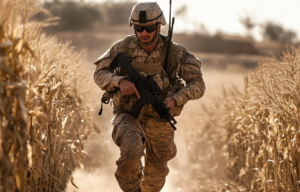
By that time, Taliban forces had shifted tactics, favoring close-range engagements over long-distance firefights to retain control of rural areas. Budd’s final combat took place in a cornfield, where tall stalks offered minimal cover and visibility was severely restricted.
His Victoria Cross citation recounts two remarkable acts of bravery. The first occurred on July 27, 2006, when his unit came under heavy fire from Taliban fighters entrenched on a rooftop. Several British soldiers were wounded and trapped, unable to retreat due to suppressive enemy fire. Demonstrating extraordinary courage, Budd exposed himself to the gunfire and charged the building.
By forcing the Taliban out into the open, he enabled his fellow soldiers to engage effectively and evacuate the wounded. This fearless action not only saved lives but also paved the way for the second act of heroism that would ultimately define his enduring legacy.
Bryan Budd was just five days from home

Bryan Budd had been slated to return home on August 25, 2006, though deployment schedules are often unpredictable. On August 20, he was stationed at a remote outpost in Sangin, tasked with its defense. Due to its isolated position, the post was under frequent threat from Taliban attacks, requiring constant vigilance and regular patrols.
During one such patrol, Budd led his team through dense, towering cornfields. Despite the limited visibility, he spotted a sizable group of Taliban fighters roughly 30 meters ahead. Opting for a tactical advantage, he chose to maneuver around them to launch a surprise flanking attack.
Before the maneuver could unfold, the Taliban detected the patrol’s approach, igniting a fierce gunfight.
Taliban insurgents versus the British Parachute Regiment

With three of his men wounded, Bryan Budd, once again, recognized the need to regain the initiative and pressed forward with the attack – alone. He rushed through the corn and assaulted the enemy. Despite being wounded in the firefight, he continued the assault, giving his men the cover needed to reorganize.
As a result of this assault, the Taliban militants were silenced and the wounded able to evacuate.
However, there was no sign of Budd as his unit withdrew. He was initially listed as missing in action (MIA) while a quick reaction force assembled to search for him. As the reactionary forces pushed through the vegetation, air power beating back the Taliban, Budd’s body was discovered lying in the field next to three dead insurgents.
Bryan Budd met a tragic end

For his actions on August 20, 2006 and a few days prior, Bryan Budd was awarded the Victoria Cross. He was one of less than 20 to receive the honor since the end of the Second World War. A subsequent examination might have proven that the fatal shot came from a 5.56 mm NATO weapon, which indicated friendly fire. However, that only occurred because he saw fit to close in and destroy the enemy.
On not one, but two occasions, Budd deemed it advisable to launch a counterattack and gift violence to the enemy, rather than receive it. An unexpected counterattack disrupts enemy momentum, but often at a great cost to those who pursue it. Budd will rest in the hall of history that recognizes him as a warrior who understood that battle is fought one moment at a time, with little disregard for when you might be going home.
More from us: James Ashworth: The Victoria Cross Recipient Who Gave His Life to Take Out An Enemy Sniper
If it’s indeed the case that Bryan Budd would have returned home with his family in just five days, then history owes him the recognition for conducting such a feat and sacrificing his life for his comrades.