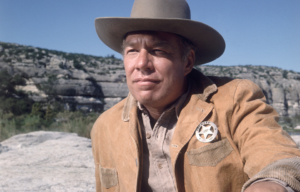
George Kennedy’s early beginnings in show business

George Kennedy was born on February 18, 1925, in New York City, New York, into a family deeply connected to the entertainment world. His father was a musician and orchestra leader, and his mother had been a ballet dancer, so he was introduced to show business at a young age.
Kennedy made his stage debut at just two years old in a touring production of Bringing Up Father. Unfortunately, his father passed away when he was four, leaving his mother to raise him alone.
Even with this loss, Kennedy stayed focused on his growing career, performing on the radio from the age of seven until the start of World War II. After graduating high school, he decided to join the U.S. Army.
Serving under Gen. George Patton

George Kennedy initially tried to enlist in the US Army Air Forces, but his physical stature posed problems.
“I’m six-foot-four, and even in those days I weighed 210 pound,” Kennedy once reminisced. “I was interested in airplanes then, and I’m interested in airplanes now. The best explanation came from a master sergeant in the Air Force. He said, ‘George, there’s nothing wrong with you. But we can either put you in an airplane or we can put a 200-pound bomb in an airplane. We’d rather put the bomb in the airplane.'”
Instead, Kennedy enlisted as an infantryman in the US Army, serving under Gen. George Patton, whom he’d later portray in 1978’s Brass Target. One of the most notable engagements he participated in was the Battle of the Bulge. Reflecting on the war later in life, he commented on the danger he and his fellow servicemen faced.
“Kids who had never done anything more dangerous than play kickball in the street were shooting BAR’s and mortars and killing each other… The war was one horrendous surprise after another. I can’t think of anything I did during the war that did not involve death,” he said.
Kennedy’s time with the military came to an end after 16 years due a back injury he suffered in the late 1950s. At the time of his retirement, he’d achieved the rank of captain and earned a number of recognitions, including two Bronze Stars.
Developing the US Army Information Office

During his Army years, George Kennedy drew on his earlier experience as a radio actor to serve as a disc jockey for the Armed Forces Network (AFN), a setting not unlike the one later popularized in the 1987 film Good Morning, Vietnam.
The role left its mark on both sides. For the Army, it played a part in the development of the U.S. Army Information Office, which went on to guide Hollywood with technical knowledge. For Kennedy, it offered valuable on-air experience that would prove instrumental in shaping his path as an actor once his military career ended.
George Kennedy always played the tough guy

After leaving the Army, George Kennedy worked as a technical advisor on The Phil Silvers Show (1955–59). In this position, he occasionally played small, uncredited characters, sparking his interest in pursuing a professional acting career. This led to supporting roles in various television series, where he often played cowboys, outlaws, or lawmen.
Although Kennedy had made several TV appearances, his film debut came in the early 1960s. Among the notable films from his early career are Charade (1963), Flight of the Phoenix (1966) and The Dirty Dozen (1967). However, his breakthrough role came with Cool Hand Luke (1967), earning him an Academy Award for Best Supporting Actor. During this period, he acted alongside some of Hollywood’s biggest stars, including Paul Newman, Cary Grant, Kirk Douglas and Joan Crawford.
Kennedy appeared in over 200 movies and TV shows

By the late 1970s and early 1980s, George Kennedy’s presence in Hollywood had waned. Once a reliable fixture in major films, he increasingly accepted smaller roles in lesser-known projects. To stay active in the industry, he turned more frequently to television, taking supporting parts that kept him in the public eye even as his star had faded.
Then, in 1988, everything shifted.
Kennedy was cast as the deadpan Captain Ed Hocken in The Naked Gun, where his understated comedic timing proved a revelation. Acting as the perfect counterbalance to Leslie Nielsen’s unpredictable Lt. Frank Drebin, Kennedy’s straight-faced delivery won over both audiences and critics. The film’s massive success not only generated laughs but also breathed new life into his career, introducing him to a younger generation of fans.
Buoyed by this resurgence, Kennedy continued acting well into the 2000s, ultimately accumulating more than 200 film and television credits. His final role came in The Gambler (2014), after which he retired. He passed away in 2016 at the age of 91.
George Kennedy’s journey serves as a testament to resilience, adaptability, and reinvention, proving that even in Hollywood, a career can make a remarkable comeback when least expected.