Although firearms are often associated with conflict during America’s westward expansion, the Lewis and Clark Expedition relied on a far less conventional weapon: the Girardoni air rifle. This sophisticated rifle could fire multiple powerful shots in quick succession, making it especially useful for hunting and helping sustain the expedition as it traveled through the frontier of the American West.
Despite its impressive capabilities, the rifle was not used against other people during the journey. Its role remained focused on survival, highlighting its importance as a practical tool rather than an instrument of combat.
Origins of the Girandoni air rifle

The air rifle employed by Capt. Meriwether Lewis and 2nd Lt. William Clark during their expedition was developed in Austria around 1778. Air guns had been a prominent hunting weapon in Europe since the 16th century, prized for their noiseless operation and lack of smoke when fired.
In 1778, Austrian gunsmith Bartolomeo Girandoni advanced the early air gun designs to create what would become the Girandoni air rifle. This model featured innovations that transformed it from a hunting tool into a military firearm.
The Girandoni air rifle was breech-loading and featured a 20-round tubular magazine along the barrel. Loading was simplified as the user could elevate the muzzle and use a spring-loaded slider to position a ball into place. This design allowed riflemen to load the weapon while lying down, a major advantage over traditional rifles that required standing.
Additionally, the rifle used compressed air rather than gunpowder for firing. The air reservoir was pressurized to around 800 pounds per square inch—much higher than the 35-40 pounds per square inch found in modern car tires.
A fully charged pressure flask was good for up to 30 shots before needing to be recharged.
Service with the Austrian Army

The Girardoni air rifle was used by the Austrian Army from 1780-1815 and was initially valued for its rapid rate of fire, quiet discharge, and lack of smoke. Over time, however, these advantages were outweighed by several practical limitations.
One major issue was the effort required to operate it. Fully pressurizing the rifle took around 1,500 strokes of a hand pump, a demanding and time-consuming process that also created a critical vulnerability—if the pump was lost or damaged, the weapon became unusable.
The rifle’s unique design also posed challenges. It required specialized training, as it functioned very differently from conventional firearms of the period. Production added another obstacle, since each unit had to be individually crafted by skilled gunsmiths, making it costly and limiting total output to an estimated 1,300 rifles.
Despite these drawbacks, the Girardoni rifle was a groundbreaking innovation. It became the first repeating rifle to see widespread military use and was among the earliest to incorporate a tubular magazine, influencing the future development of firearms.
Origins of the air rifle used on the Lewis and Clark Expedition

In 1804, Meriwether Lewis wrote that he had purchased an air gun, but didn’t allude to where or from whom he’d purchased it. Historians have debated between two possibilities: that the weapon was made in America and later sold to Lewis or that it was actually the Girandoni air rifle, which was manufactured in Europe and somehow brought to the United States.
Initially, the conclusion was that Lewis had purchased the air rifle from Isaiah Lukens of Philadelphia, who either made it himself or had his father, Seneca Lukens, craft it. In 1846, 40 years after Lewis and William Clark returned from their expedition, an auctioneer’s pamphlet advertised the sale of Lukens’ possessions. This included several air guns, canes and a “large air gun made for and used by Messrs Lewis & Clark in their exploding expeditions. A great curiosity.”
It should be noted that the pamphlet never states Lukens made the rifle himself. As well, in 2002, gun historian Michael Carrick determined that he wasn’t known to have been in business in Philadelphia prior to 1814. In 1803, when Lewis bought it, Lukens was still an apprentice to his father in Horsham Township, located 15 miles north of Philadelphia.
Historians now believe Lewis took a Girandoni air rifle on his expedition. An Austrian government report from January 20, 1801, states that 399 had been lost in battle, meaning there’s an increased possibility of the higher transfer of air guns in Europe and America. Furthermore, while there are no descriptions of the air rifle provided by Lewis, other eyewitness descriptions appear to have major similarities to the one produced by Girandoni.
How did Meriwether Lewis and William Clark use the air rifle?

Regardless of how Meriwether Lewis acquired his air rifle, it became an essential tool in his expedition with William Clark. The Lewis and Clark Expedition moved across the newly-acquired western portion of the United States after the Louisiana Purchase in 1803. The purpose was to explore, chart and map this new territory.
Lewis didn’t see his air rifle as a weapon; rather, he saw it as a way to impress the various Native American tribes they’d likely encounter on their journey. In fact, the Lewis and Clark air rifle is mentioned at least 39 times in journals written during the expedition.
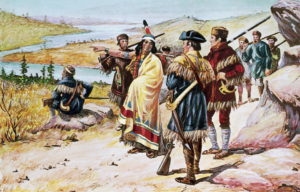
When the men involved in expedition encountered Native Americans, they did their best to impress them through pomp and ceremony. Lewis and Clark often wore their most colorful military uniforms, with their flags flying and fifes whistling. They’d meet with the group and proceed to hand out different gifts, including colored cloth, commemorative medallions and beads.
At some point during this “ceremony,” Lewis would take out his air rifle and shoot it a few times, confident he’d impress his audience.
Impressed by the air rifle

Take, for example, the reaction of the Teton Sioux, who witnessed Meriwether Lewis fire his air gun in a ceremony held on August 30, 1804. The diary account by Joseph Whitehouse, who served as a tailor on the Lewis and Clark Expedition, states:
“Captain Lewis shot his air gun and told them there was medicine in her and that she would do great execution. They were all amazed at the curiosity and soon as he had shot a few times, they all ran hastily to see the ball holes in the tree. They shouted aloud at the site of the execution, they were all amazed at the curiosity.”
Native Americans were likely impressed by the rifle because it was a technology they hadn’t yet seen. The gunstock reservoir was pumped up before the ceremony, meaning there was hardly any evidence that the weapon’s power was man-made. There was no ramming of the ball into the barrel, no primer in the pan, no flash when fired, no smoke produced and several bullets were able to be shot without a pause for reloading.
Perhaps it was for this reason – the curiosity and wonder surrounding the air rifle – that the expedition could pass through Native American villages safely. However, as air rifle and Lewis and Clark expert Robert Beeman points out, “We must avoid the very misleading thought that the Girandoni rifle opened or won the West. Rather, it was the key to Lewis and Clark returning alive and promoting the West.”
Intimidation and close calls

Meriwether Lewis and William Clark’s air rifle wasn’t just used to impress Native Americans – it was also used to intimidate them. One such instance occurred on April 3, 1806, along the banks of the Columbia River, near modern-day Portland, Oregon. Clark wrote that canoes of men, women and children came into their camp. There were about 37 people there at one time, so Lewis fired his weapon, which “astonished them in such a manner that they were orderly and kept at a proper distance during this time.”
There was only one instance in the entire three-year expedition that the air rifle was nearly used in the way it was intended. On August 11, 1806, Lewis was struck by a stray bullet in the leg and believed they were being ambushed. In response, he grabbed both his regular weapon and his air rifle to protect himself. However, the stray bullet had come from one of his own men, rather than a surprise ambush, and the rifle continued to be used for ceremonial purposes only.
Coincidentally, this was the last mention of it in expedition journals.
When the expedition ended in late August 1806, Lewis and Clark returned home, feeling excited about their successful mission. Soon after, however, the air rifle disappeared. For over a century, historians only had descriptions from the expedition journals, and it wasn’t until recently that the rifle reappeared, seemingly out of thin air.
Rediscovering the air rifle used on the Lewis and Clark Expedition

When historians first learned that Meriwether Lewis had brought an air rifle on the expedition, they assumed it relied on a ball-shaped reservoir mounted beneath the breech—a common feature in 18th-century European sporting air guns.
The true breakthrough came in 1977, when gun historian Henry M. Stewart, Jr. uncovered an auction pamphlet from Isaiah Lukens’ estate, offering critical clues about the rifle’s actual design.
Decades later, in 2004, air gun expert Robert Beeman entered the picture. Master gunsmith Ernie Cowan, hoping to replicate a Girandoni rifle in his collection, enlisted Beeman’s expertise. When Cowan and his associate Rick Keller disassembled the weapon, they noticed signs of previous repairs. Consulting Michael Carrick, they confirmed that the repairs matched exactly the entries Lewis recorded in his expedition journals, providing a tangible link between the historic rifle and the explorers’ accounts.
More from us: Bell P-39 Airacobra: World War II’s Most Controversial Low-Altitude Fighter
Beeman, who recognized the historical significance of the air rifle, donated the weapon to the permanent collection of the US Army War College in Carlisle, Pennsylvania.